

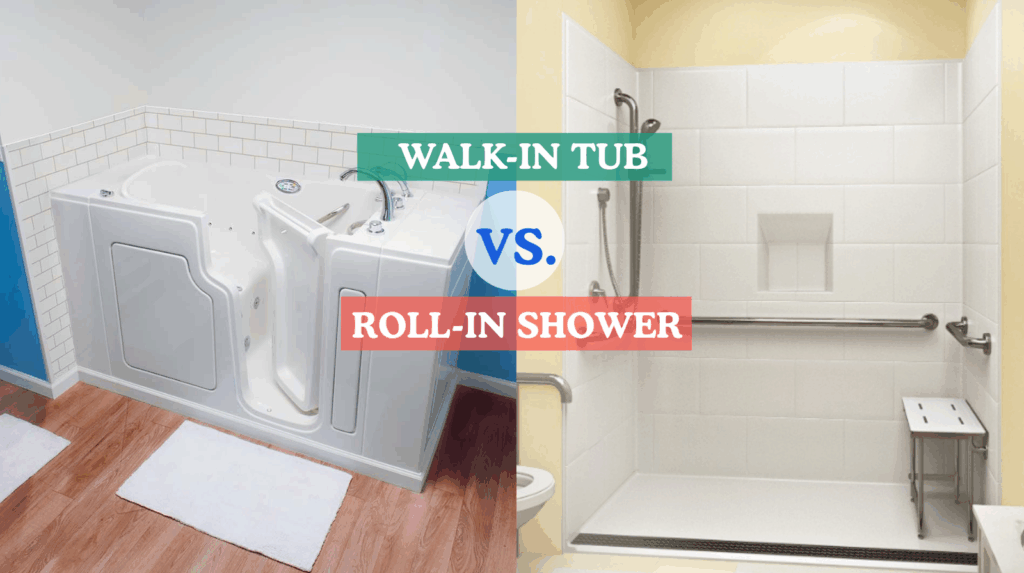

You’ve decided that your standard bathtub is no longer safe. The high rim feels like a hurdle, and the fear of a slip-and-fall is keeping you from enjoying your daily routine. You know you need a change to continue aging in place safely, but you are stuck between two popular options: a Walk-in Tub or a Roll-in Shower.
One offers the luxury of a deep soak and hydrotherapy, while the other offers the ultimate ease of “zero-entry” access.
For a senior on a fixed income, this isn’t just a comfort choice—it’s a major financial investment ranging from $5,000 to $15,000. Making the wrong choice can lead to a “re-do” in three years if your mobility needs change, doubling your costs.
As your trusted advocate, we have performed a Sagewise Audit of both modifications. We will break down the “Mobility Math,” compare the long-term costs, and help you choose the shield that best fits your physical needs and your retirement budget.
Key Takeaways
- The Wheelchair Factor: If you use a wheelchair or expect to soon, a Roll-in Shower is the only safe option.
- The Therapy Factor: If you suffer from chronic arthritis or poor circulation, a Walk-in Tub provides medical hydrotherapy that a shower cannot.
- The Cost Gap: Roll-in showers are generally $3,000 to $5,000 cheaper to install than high-end walk-in tubs.
- The Space Rule: Walk-in tubs fit in your existing tub’s footprint; roll-in showers often require expanding the floor area.
Safety modifications shouldn’t lead to high-interest debt. Clear your existing balances and find room for your home upgrades.
Explore Debt Relief Options
The Sagewise Audit: Side-by-Side Comparison
To find the right fit, you must match the modification to your “Body Type” and future mobility outlook.
|
Feature
|
Walk-in Tub
|
Roll-in (Curbless) Shower
|
|---|---|---|
|
Primary Benefit
|
Therapeutic soaking/massage.
|
Universal access (Wheelchair).
|
|
Entry Threshold
|
3 - 6 inches (Step required).
|
0 inches (Flat entry).
|
|
Water Usage
|
High (60-80 gallons).
|
Low (Standard shower head).
|
|
Install Time
|
1 - 2 Days.
|
3 - 5 Days (Requires floor slope).
|
|
Est. Cost
|
$10,000 - $17,000
|
$6,000 - $12,000
|
1. The Walk-in Tub: The "Therapy" Choice
A walk-in tub is a specialized piece of medical equipment. It is best for seniors who still have the balance to step over a small threshold but need high-level help managing chronic pain, inflammation, or circulatory issues.
- Pros (Clinical Benefits): As we noted in our Big Three brand audit, the primary draw is hydrotherapy. Immersing the body in warm water reduces the effects of gravity on joints, while water and air jets stimulate endorphin release. This is a legitimate medical “shield” for those with severe osteoarthritis or diabetic neuropathy.
- The “Safety Enclosure”: Unlike a shower where you are standing or perched on a bench, a tub provides an enclosed environment. The high walls and integrated grab bars offer a sense of security for those who suffer from occasional dizzy spells or “orthostatic hypotension” (dizziness when standing).
- Cons (The “Shiver” Factor): Because the door is part of the tub wall, you must sit in the tub while it fills and wait for it to fully empty before you can open the door. If your home has a slow water heater or poor drainage, you could be sitting naked and wet for 10-15 minutes.
- Sagewise Verdict: Choose the tub if your primary goal is pain management and you are confident in your ability to stand and step 3-4 inches. It is a “luxury safety” item that prioritizes comfort over speed.
2. The Roll-in Shower: The "Future-Proof" Choice
A roll-in (or curbless) shower removes the “barrier” entirely. The bathroom floor simply continues into the shower area at a slight slope toward a linear drain.
- Pros (Universal Access): It is the only true ADA-compliant solution for wheelchair or walker users. There is zero risk of tripping because there is no edge to step over. From a “Financial Advocate” perspective, this is the most Future-Proof investment. Even if your mobility declines to the point of needing a total lift or caregiver assistance, the roll-in shower remains 100% usable.
- Caregiver Integration: A roll-in shower is significantly easier for a spouse or home-health aide to assist you in. There is enough room for two people, and the lack of walls allows for a “hand-off” of the shower sprayer without reaching over a tub rim.
- Cons (The “Drafty” Experience): Because there is no high wall to trap steam, curbless showers can feel colder than an enclosed tub. You are also relying on a shower bench, which may feel less stable to some than the molded, reinforced seat of a walk-in tub.
- Sagewise Tip: Ensure your contractor uses a collapsible water dam. This is a soft rubber strip that keeps water in the shower but flattens out when a wheelchair rolls over it. Also, demand a “Linear Drain”—a long, thin grate at the entrance that catches water more efficiently than a single center hole.
The "Mobility Forecast": Don't Buy Twice
When seniors search for “best bathroom mods for seniors 2026,” they often forget to look five years into the future.
The Question: If you have a progressive condition like Parkinson’s or Multiple Sclerosis, will you be able to step into a walk-in tub in 2029?
- The Risk: A walk-in tub still requires you to stand and step. If your balance declines to the point where you need a wheelchair, a $15,000 walk-in tub becomes an expensive obstacle that must be ripped out.
- The Financial Guardrail: If you are unsure about your future mobility, the Roll-in Shower is the safer financial move. It is “universally designed,” meaning anyone from a toddler to a person in a wheelchair can use it safely for the life of the home.
Home Equity Calculator
Whether you choose a tub or a shower, these modifications are high-ticket items. Use our Home Equity Calculator to see if a Reverse Mortgage or HELOC is a safer way to fund your safety than draining your emergency cash.
Frequently Asked Questions (FAQ)
The Roll-in Shower generally has better resale value. Modern buyers prefer large, walk-in showers over tubs. A walk-in tub is a very niche medical item that a younger family might see as something they have to pay to remove later.
No. As we detailed in our guide Does Medicare Pay for Walk-in Tubs?, Original Medicare considers both to be “home modifications” rather than medical equipment. You will need to look into VA grants or Medicaid waivers for funding.
Yes. If you want the soak but use a wheelchair, a Slide-in Tub has a seat at wheelchair height and a door that opens wide. This allows you to transfer from your chair directly onto the tub seat. These are specialized and can cost $15,000+.
Yes, but it is a complex job. The floor must be “recessed” or the entire bathroom floor must be raised to create the necessary drainage slope. This is why the installation cost for a shower can sometimes equal the cost of a tub.
The Roll-in Shower is significantly easier to clean. Walk-in tubs have complex internal plumbing and jet systems that require regular “Ozone” or chemical flushes to prevent mold and bacteria buildup.
Explore Debt Relief Options (Prioritize your home safety without sacrificing your retirement security today.)