

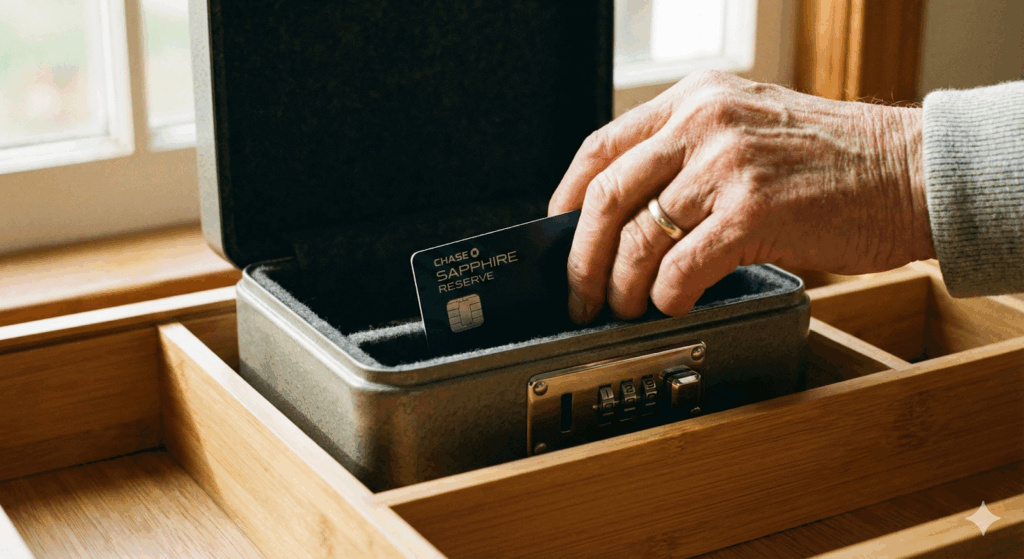

As you enter retirement, the urge to simplify is strong. You are downsizing your home, decluttering your garage, and naturally, you want to clean up your wallet.
If you have an old credit card you haven’t used in years, your instinct might be to call the bank and cancel it. It feels responsible. It feels tidy.
Stop. Before you make that call, you need to know the hidden cost.
Closing an old credit card is often one of the fastest ways to accidentally lower your credit score. Even if you have perfect payment history, hitting “cancel” can erase decades of good data from your report.
As your trusted advocate, we are here to explain the “credit math” behind this decision and offer a smarter, safer way to declutter your finances without hurting your score.
Key Takeaways
- History Matters: Your credit score relies heavily on the “Average Age” of your accounts. Closing an old card shortens that history.
- Utilization Spike: Closing a card removes its credit limit from your profile, which can make your debt look higher to lenders.
- The Exception: You should close a card if it charges an annual fee that you aren’t using.
- The Solution: Use the “Sock Drawer Method” to keep the account open and the score healthy without carrying the card.
The "Credit Score Math": Why Closing a Card Hurts
Your FICO credit score is calculated using five factors. Closing a card negatively impacts two of the biggest ones, potentially causing a drop right when you need your score for insurance rates or co-signing.
1. Length of Credit History (15% of Score)
Lenders like to see that you have managed credit responsibly for a long time. This factor looks at the age of your oldest account and the average age of all your accounts.
- The Scenario: You have a card you opened 20 years ago and another one you opened 2 years ago.
- The Mistake: If you close the 20-year-old card because you “don’t use it anymore,” you are removing your longest track record of success. Your credit history suddenly looks much shorter and less established.
- The Rule: The older the card, the more valuable it is to your score. It acts as an anchor, proving your long-term reliability. Never close your oldest card.
2. Credit Utilization Ratio (30% of Score)
This is the most immediate danger. Utilization measures how much of your available credit you are currently using. It compares your total debt to your total credit limit. If you close a card with a high limit (even if it has a $0 balance), you lose that “buffer,” making your remaining debt look much riskier to the credit bureaus.
See the math below:
|
Scenario
|
Total Debt
|
Total Credit Limit
|
Utilization Ratio
|
Impact on Score
|
|---|---|---|---|---|
|
Before Closing
|
$2,000
|
$10,000 (Two Cards)
|
20% (Safe)
|
Positive
|
|
After Closing Card B
|
$2,000
|
$5,000 (One Card)
|
40% (High)
|
NEGATIVE
|
The Verdict: Even though you didn’t spend a single extra penny, closing the second card made you look twice as risky to the credit bureau because you are now using a much larger percentage of your available credit. Keeping that unused limit open protects your score.
The "Sock Drawer Method": How to Declutter Safely
You don’t need to carry a card to keep it open. Use this simple strategy to simplify your wallet while protecting your score.
- Pay It Off: Ensure the balance is $0.
- Lock It: Log into the bank’s app and “Lock” the card so it can’t be used for fraud.
- Hide It: Put the physical card in a safe place at home (like your sock drawer or a fireproof box).
- Keep it Active: Once a year, take it out to buy a small item (like a coffee) and pay it off immediately. This prevents the bank from closing it for inactivity.
💡 Wise Tip from Sagewise: The “Subscription Trick” If you are worried you will forget to use the card, put a small recurring subscription on it (like Netflix or a $5 charity donation) and set up Auto-Pay. This keeps the card “active” automatically every month without you ever having to touch it.
Replacing a Bad Card? Top Picks for Seniors
Sometimes, you have to close a card (e.g., to avoid a high annual fee). If you do, consider replacing it immediately with a better, no-fee option to protect your total credit limit.
1. The Simple Replacement: SoFi Unlimited 2% Credit Card
Sagewise Rating: 5.0
- Why it wins: If you are closing a complex travel card with a fee, replace it with this. It has No Annual Fee, earns a flat 2% cash back on everything, and offers $0 Fraud Liability. It’s the perfect “set it and forget it” card for a senior’s wallet. View Offer
2. The Credit Rebuilder: Indigo Platinum Mastercard®
Sagewise Rating: 4.0
Why it wins: If you accidentally hurt your score by closing old accounts, this is a great tool to rebuild. It is an unsecured card (no deposit needed) designed for less-than-perfect credit. It reports to all three bureaus to help get your score back on track. Check Pre-Approval
The Safe Exit Strategy: 4 Steps Before You Cancel
If you must close a card (e.g., to avoid an annual fee or remove an ex-spouse), follow this checklist to do it without losing money.
1. Redeem All Rewards: Check your points or cash back balance. If you close the account, you forfeit any unredeemed rewards instantly. Use them or lose them.
2. Zero Out the Balance: You cannot close a card that has a balance. Pay it off in full first.
3. Update Auto-Pays: Review your statements for the last 12 months. Did you have an annual magazine subscription or insurance bill linked to this card? Move them to a new card to avoid missed payments.
4. Request a Confirmation Letter: When you call to cancel, ask the bank to send you a written confirmation that the account was “Closed at Consumer’s Request.” This looks better on your credit report than “Closed by Creditor.”
Your “Keep or Cancel” Decision Tool
Run your old cards through this checklist to decide their fate.
- 1. Does the card have an Annual Fee?
- [ ] Yes: Call the bank. Ask to downgrade to a no-fee card. If they say no, Cancel It.
- [ ] No: Keep reading.
- 2. Is it your oldest credit card?
- [ ] Yes: Keep It Open. (Use the Sock Drawer Method).
- [ ] No: Keep reading.
- 3. Does it have a high credit limit ($5,000+)?
- [ ] Yes: Keep It Open. (Losing this limit will hurt your utilization ratio).
- [ ] No: It is safe to close if you really want to.
Frequently Asked Questions (FAQ)
No. There is no penalty for having “too many” cards with a $0 balance. In fact, having many accounts with zero balance and a long history shows lenders you are responsible.
Yes. If a card sits dormant for 12–24 months, the issuer may close it for inactivity. To prevent this, use our “Subscription Trick” (above) or buy a small item once a year.
In this case, closing the account is often the only way to sever the financial tie. The dip in your credit score is worth the legal and financial separation.
Sometimes. If you have two cards with the same bank (e.g., two Chase cards), you can often ask them to move the credit limit from the card you want to close onto the card you want to keep. This saves your “Utilization Ratio” even if you close the account.
Positive information from a closed account remains on your credit report for 10 years. This means your score won’t drop due to “history length” immediately, but it will drop eventually. Keeping it open preserves that history forever.
Find a Safer Credit Card (Looking for a card worth keeping? Find a no-fee cash back card today.)