



In 2026, the greatest threat to a senior’s credit card security isn’t a lost wallet or a hacked database—it’s Emotion. A new, terrifying breed of criminal is using Generative AI to clone voices with almost 100% precision. Using just a five-second clip harvested from a social media video, a scammer can call you and sound exactly like your son, daughter, or grandchild.
This isn’t just a “phishing” email; it’s an Auditory Deepfake. The scenario is almost always a “Credit Card Emergency”:
“Grandpa, I’m at the hospital/police station/airport, and my card was declined. It’s an emergency. I need your card number, expiration date, and that 3-digit code on the back right now or I can’t leave.”
The voice is panicked. It’s crying. It uses your nickname. Your logical brain shuts down, and your protective heart takes over. As your Financial Bodyguard, I am here to tell you: Do not trust the voice. In 2026, you must trust the audit, not the auditory.
The Technical Audit: How Voice Cloning Fraud Works
To defend yourself, you must understand the Math of the Mimic. The old “Grandparent Scams” of 2020 relied on bad phone connections, background static, and vague descriptions (“It’s your favorite grandson!”). Those days are gone.
In 2026, “Generative adversarial networks” (GANs) analyze a target’s voice profile with terrifying speed. Scammers only need a small “sample” (harvested from TikTok, YouTube, or Facebook) to reverse-engineer a person’s unique voice print.
The Anatomy of the "Mimic"
A standard AI voice-cloning algorithm analyzes over 250 unique vocal markers, focusing on:
- Fundamental Frequency (Pitch): The natural “high” or “low” of the family member’s voice.
- Formant Frequencies: The unique acoustic fingerprint created by their vocal tract (which makes a “son” sound different from a “daughter”).
- Speech Patterns (Prosody): The specific slang, the speed of their speaking, and even where they usually place pauses like “ums,” “like,” or “you know.”
- Emotional Overlay: Crucially, the AI can apply a “panicked” or “distressed” filter over the cloned voice. Scammers intentionally use distress because they know it bypasses a senior’s critical thinking.
The Psychological Vishing Attack
“Vishing” is the term for “Voice Phishing.” Scammers aren’t just technical experts; they are masters of psychology. They know that if they can trigger a Fight or Flight response in your brain, you won’t ask standard security questions.
The Fraudster's Playbook
Scammers create a crisis (hospital, jail, customs) that demands immediate action. “I need it NOW.”
AI clones have a remarkably emotional range in 2026. The crying “grandchild” will often start a sentence, “stop” to cry or hyperventilate, and then continue. This sounds authentic to our protective instincts.
Scammers will claim they are using a friend’s phone or a police officer’s phone, anticipating that you will want to call them back.
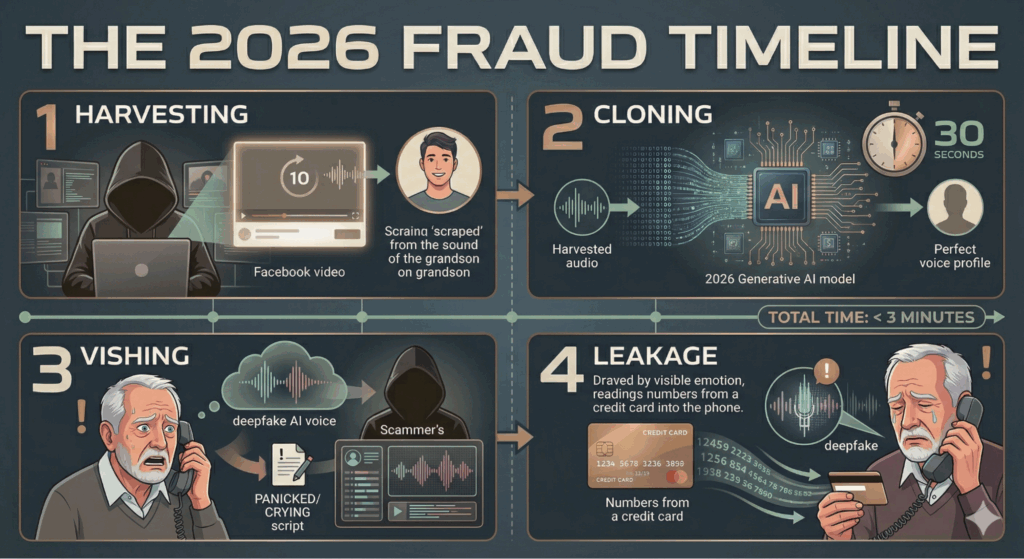
The 2026 Fraud Timeline
- Harvesting: A scammer copies audio from a 10-second Facebook video of a “grandson” talking.
- Cloning: The audio is run through a 2026 Generative AI model. (30 seconds).
- Vishing: The scammer calls the senior, overlaying the AI voice with a “panicked/crying” script.
- Leakage: The senior, driven by emotion, reads their credit card number over the phone to the deepfake. Total Time: < 3 Minutes.
The Technical Audit: How to Spot an AI Voice
In 2026, the technology is so advanced that your ear alone cannot detect the difference. However, the AI still has minor “glitches.”
Auditory Red Flags Table
|
The Human Voice (Legacy)
|
The AI Deepfake (Zombie)
|
|---|---|
|
Random emotion (Laughs or sighs at odd times).
|
Flattened affect when they think you aren't listening.
|
|
Stutters or "repeats" words naturally.
|
Speaks in perfect, flowing sentences (unless programmed to stutter).
|
|
Background noise matches their story (sirens at a police station).
|
Background noise is often silent or "canned" static.
|
|
Can instantly answer obscure personal questions.
|
Can only answer pre-programmed responses.
|
|
Vocal Fatigue: Their voice changes over a long call.
|
No Fatigue: They sound identical for an unlimited duration.
|
sageWISE Tip: If you suspect an AI clone, ask an obscure question that only the real person would know: “What did we eat for dinner last Thanksgiving?” or “What is the name of the neighbor’s cat?” The AI is likely connected to a real human scammer, but they don’t have access to your family’s daily trivia.
The "Family Password" Shield: Your First Line of Defense
The most effective, un-hackable defense against AI voice cloning is low-tech: A Family Password.
Every family should have a non-obvious word or phrase that must be shared before any sensitive financial data—especially a full credit card number, expiration date, and CVV code—is shared over the phone.
Rules for a Strong Family Password
- Do Not Use: Names, birthdays, addresses, or pets (scammers can find this on social media).
- Do Use: An obscure, easily remembered word (“Blueberry,” “Falcon,” “Tuba”) or an inside joke.
- Do Refresh: Change the password once a year, just like your other sensitive logins.
If the “grandchild” claiming an emergency cannot provide the family word, hang up. Do not engage. Your Financial Bodyguard is telling you that the call is a Deepfake.
The "Red Phone" Protocol: Official Emergency Steps
If you receive a call that sounds like a family emergency, follow these steps approved by 2026 consumer protection agencies. Safety first—audit second.
1. The "Proof of Life" Question (The 10-Second Test)
Instead of hanging up immediately (which could be dangerous in a real crisis), stay on the line but ask a “Safe Question.” This is a question only the real person could answer that is not on social media.
- The Question: “I’m here, I’m listening. Tell me, what was the name of the dog we had when you were five?” or “What did we eat for dinner last Thanksgiving?”
- The AI Glitch: AI clones are programmed with a script, not a memory. If the caller dodges the question or gets aggressive, that is your signal that this is a “Zombie” call.
2. The "Parallel Dial" (The Multi-Phone Check)
Do not hang up. If you have a second phone (a spouse’s phone or a landline), use it to call the family member’s known cell phone or their parents while the suspicious caller is still on the line.
- Why? Scammers want you to hang up so they can “claim” your phone line. By using a second device, you bypass their trap entirely.
- Official Advice: If the caller claims to be a police officer or hospital admin, ask for their name and “badge number,” then call the official department number found on Google—not the number they provide.
3. The "Financial Firewall"
No matter how real the voice sounds, a legitimate emergency institution (hospital, jail, or airport) will never ask for:
- Credit card numbers over a personal phone line.
- Payment via Gift Cards, Cryptocurrency, or Zelle.
- Official Step: Tell the caller, “I will contact the facility’s billing department directly to handle the payment.” A scammer will try to stop you; a real official will encourage it.
Table: AI Scam vs. Real Emergency Audit
|
Feature
|
The AI Voice Scam (The Zombie)
|
A Real Family Emergency
|
|---|---|---|
|
Payment Method
|
Demands Gift Cards, Crypto, or CVV.
|
Uses official billing portals.
|
|
Personal Knowledge
|
Fails the "Pet Name" or "Memory" test.
|
Passes personal trivia instantly.
|
|
Reaction to Call-Back
|
Panics or says "No, don't hang up!"
|
Says "Yes, call me right back."
|
|
Demands secrecy ("Don't tell Mom").
|
Demands secrecy ("Don't tell Mom").
|
Encourages calling other family for help.
|
|
Audio Quality
|
May have subtle "robotic" artifacts.
|
Clear, natural background noise.
|
Frequently Asked Questions (FAQ)
Yes. In 2026, AI cloning is 99% accurate. You cannot rely on “knowing” the voice anymore.
Scammers often use AI calls to “fish” for that final piece of the puzzle. Never give out the CVV code.
Yes. If you give a scammer your debit card info, the money is gone instantly. Credit cards offer a Liability Shield that protects your actual cash.
Some 2026 smartphones have “AI Call Screening,” but they are not 100% foolproof. Your brain—and your family password—is the best filter.
Call your bank’s fraud department immediately using the number on the back of your card. Freeze the account and request a new card number.
Financial Bodyguard Resources
Protect your accounts so that even if a scammer gets a card number, the damage is capped with our direct-link Sagewise tools:
- Audit Your Monthly Leakage: Use a card with the best fraud protection for your daily bills.
- Find Hidden Savings: Free up cash so you have a “Real Emergency Fund” that isn’t tied to your primary credit line.
- Calculate Your New Income: Ensure your long-term wealth is in a secure, audited account.
Secure Your Family’s Border Today
Don’t let “auditory emotion” drain your credit line. The best defense is a protected account from a top-tier 2026 issuer. Audit your cards and find the issuers that offer the most advanced biometric security today.