

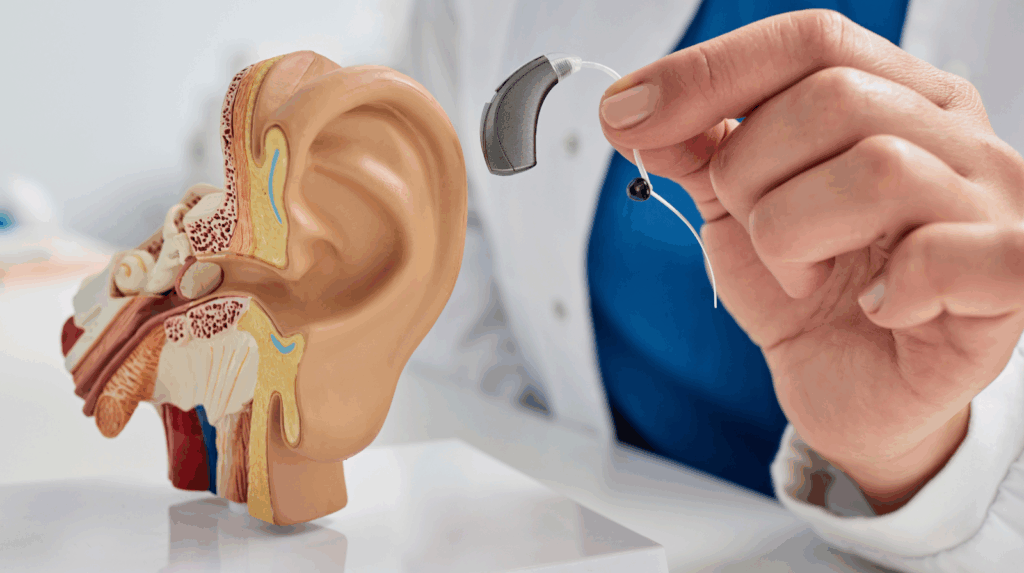

Until recently, if you had hearing loss, you had one choice: visit an audiologist and pay between $4,000 and $7,000 for a pair of prescription hearing aids. Because Medicare doesn’t cover dental, vision, or hearing, most seniors were forced to drain their savings or take on high-interest medical debt just to hear their grandchildren speak.
The “Hearing Monopoly” has finally been broken.
Thanks to a landmark 2022 FDA ruling, a new category called Over-the-Counter (OTC) Hearing Aids has hit the shelves. You can now buy hearing technology at Best Buy, Amazon, or your local pharmacy for as little as $500 to $1,500.
But as your trusted advocate, we have to ask: Is a $500 device a miracle for your budget, or is it a “cheap amplifier” that will damage your ears? As your financial bodyguard, we have audited the 2026 OTC market to show you who can safely save $5,000 and who still needs a specialist to avoid the trap of “buying twice.”
Key Takeaways
- The Price Gap: OTC aids cost 80% less than prescription models, potentially saving you over $5,000 in out-of-pocket costs and interest fees.
- Target Audience: OTC is legally only for mild-to-moderate hearing loss. If you struggle to hear in quiet rooms, OTC won’t be enough.
- The “Self-Fit” Reality: You are the doctor. You must set up and adjust OTC aids yourself using a smartphone app and Bluetooth technology.
- The “Scam” Filter: Beware of “Personal Sound Amplification Products” (PSAPs) marketed as hearing aids. If the box doesn’t say “FDA-Cleared,” do not put it in your ear.
Protect your savings from high-cost medical bills. Discover safe ways to manage your debt today.
Explore Debt Relief Options
The Financial Showdown: OTC vs. Prescription
To understand if the $500 pair is a “steal,” you have to look at what you are actually paying for. Prescription aids include the cost of the professional’s time (the “unbundled” vs. “bundled” model), while OTC is purely for the hardware.
|
Feature
|
Over-the-Counter (OTC)
|
Prescription (Audiologist)
|
|---|---|---|
|
Average Cost (Pair)
|
$500 - $1,500
|
$4,000 - $7,000
|
|
Who Fits It?
|
You (via Smartphone App)
|
Licensed Audiologist
|
|
Trial Period
|
Standard (30-45 days)
|
Professional adjustments included
|
|
Technology
|
Good (Digital, Bluetooth)
|
Superior (AI noise filtering)
|
|
Repair Policy
|
"Manufacturer Mail-in"
|
In-office cleanings and repairs
|
|
Verdict
|
The "Debt-Free" Winner
|
Best for Severe/Complex Loss
|
The Math of Debt Prevention: If you finance $5,000 for prescription aids at a 24% interest rate over three years, your total cost is:
$5,000 (Principal)} + $2,030 (Interest) = $7,030
Choosing a high-quality $1,000 OTC pair saves you a total of **$6,030 in principal and interest.** That is enough to pay for six months of groceries or a significant Home Repair.
The "Scam" Warning: Hearing Aids vs. PSAPs
If you search for “cheap hearing aids for seniors,” you will see ads on Facebook and late-night TV for $50 “miracle” devices. These are the “Bodyguard Red Flags” you must watch for.
- The Trap: These are not hearing aids. They are PSAPs (Personal Sound Amplification Products). They are basically “loudspeakers” for your ears. They don’t have the sophisticated digital processors needed to filter out background noise; they just make everything louder, which can actually cause further permanent hearing damage.
- The Bodyguard Rule: Legitimate OTC hearing aids must be FDA-Cleared. If the website or box doesn’t explicitly state “FDA-Cleared Hearing Aid,” it is a PSAP. Stick to trusted 2026 brands like Sony (CRE-C10), Jabra Enhance, or Lexie.
- The “Invisible” Bait: Scammers often use photos of tiny, invisible devices. If a device is smaller than a coffee bean and costs $50, it is likely a plastic shell with a cheap microphone.
The "Mild-to-Moderate" Test: Are You a Candidate?
Before you skip the audiologist to save money, perform this honest self-audit. OTC aids are only designed for the “Mild-to-Moderate” category. Attempting to use them for severe loss is a waste of $500.
You are a good candidate for OTC ($500-$1,500) if:
- You can hear fine in a one-on-one conversation in a quiet room.
- You primarily struggle in noisy environments like restaurants (the “cocktail party effect”).
- You turn the TV volume up just 2 or 3 notches higher than your spouse.
- You occasionally miss high-pitched sounds like birds chirping or a microwave beep.
You need a Prescription ($4,000+) if:
The "Cognitive Debt" Trap
Many seniors delay buying hearing aids because of the cost, choosing to live in silence to “save money.” From a Debt Relief perspective, this is a dangerous financial error.
- The Link to Dementia: Multiple studies, including research from The Lancet Commission, have identified hearing loss as the #1 “modifiable” risk factor for dementia.
- The Financial Cost of Delay: Untreated hearing loss leads to social isolation, which accelerates cognitive decline. The cost of Memory Care or a Nursing Home averages $6,000 to $9,000 per month.
- The ROI: Spending $1,000 on OTC hearing aids today is “Longevity Insurance.” If it helps you stay independent and out of a facility for just one extra month in the future, the devices have already paid for themselves 8 times over.
Interactive Tool: Final Expense Calculator
Major medical purchases like hearing aids often compete for the same dollars you use for legacy planning. Use our Final Expense Calculator to ensure your health choices today don’t leave your family unprotected tomorrow.
How to Buy OTC Without Getting Ripped Off
If you’ve decided to go the OTC route to avoid medical debt, follow this “Financial Bodyguard” buying protocol:
- Prioritize Bluetooth & Apps: Ensure the aids connect to your smartphone. The app is how you will perform your “self-fitting” hearing test and adjust the frequency response to match your specific loss.
- The “Free Look” Window: Never buy a device with less than a 45-day money-back guarantee. Your brain needs at least 21 days to “re-learn” how to process new sounds.
- Check for “Self-Fit” vs. “Preset”: Some cheap OTC aids only have 3 volume settings. You want “Self-Fitting” models that allow you to customize the sound profile (Equalizer) via an app.
- Avoid High-Interest Financing: If you can’t pay cash for the $800 pair, use a 0% APR Credit Card rather than the store’s “Buy Now, Pay Later” plan which often carries 30% interest.
Frequently Asked Questions (FAQ)
Sometimes. Many Advantage plans (Part C) provide an OTC Allowance (e.g., $100 per quarter) that you can use at CVS or Walgreens. Some premium plans are now allowing you to apply your full “Hearing Aid Allowance” toward high-end OTC models from Sony or Jabra.
Most audiologists will refuse to program OTC devices because they use proprietary smartphone software rather than clinical programming cables. If you buy OTC, you must be comfortable using a smartphone app for all adjustments.
No. Many modern OTC models from brands like Sony (CRE-E10) and Eargo look like high-end “earbuds” or are virtually invisible “Completely-in-the-Canal” (CIC) models.
Costco is a hybrid. They sell Prescription-grade aids at near-OTC prices (approx. $1,500). They provide the professional fitting and follow-up for free. For most seniors with a membership, Costco is the “Gold Standard” for value.
While prescription aids have specific “tinnitus sound generators,” simple amplification from an OTC aid can often reduce the perception of ringing by bringing in more environmental sound (masking). However, if your ringing is severe, see a doctor to rule out underlying medical issues.
Explore Debt Relief Options (Protect your retirement from the high cost of medical gaps today.)