

If your homeowners insurance renewal arrived with a higher premium this year, you are not alone. Many adults aged 45 to 70 who own older homes have seen noticeable increases. For people living on fixed or semi-fixed incomes, even a few hundred extra dollars a year can feel like a real squeeze.
The good news is that rate shocks are not inevitable, and they do not always mean you must simply absorb the increase. Understanding why premiums rose, which discounts seniors can still claim, and how to shop carefully can restore a sense of control. This guide walks through the practical steps that matter most right now.
Key Takeaways
- Older homes often carry higher premiums because insurers price the risk of aging systems, not the calendar year alone.
- Rate increases slowed in the first half of 2026 compared with prior years, yet many seniors still face higher bills at renewal.
- Senior-specific and retiree discounts exist with certain carriers, including programs available through AARP membership.
- Homeowners insurance covers sudden events such as fire or wind damage. It does not cover normal wear and tear. That distinction is critical when evaluating a home warranty.
- Shopping multiple quotes before a reverse mortgage or refinance application can prevent force-placed insurance traps later.
Why Premiums Keep Rising for Older Homes
Insurers do not raise rates because a house turns 40 or 50. They raise rates when the cost of potential claims climbs. Older roofs, outdated electrical systems, and aging plumbing increase both the chance of a claim and the cost to repair or rebuild. National data shows older homes can cost substantially more to insure than newer ones at the same coverage level. One analysis found the gap can reach 69 percent at basic coverage amounts.
Climate-related losses and higher construction costs have added pressure industry-wide. Average approved rate increases slowed to about 4.3 percent in the first half of 2026 after steeper rises in earlier years. Even so, many policyholders still see larger individual increases at renewal because of their specific home profile or location. Replacement-cost inflation means the same house simply costs more to rebuild today than it did five years ago.
For seniors, the impact is magnified. A higher premium comes out of Social Security, a pension, or retirement savings. There is little room to absorb repeated double-digit jumps without cutting elsewhere.
Senior-Specific Discounts and How to Claim Them
Age alone does not usually raise or lower a homeowners premium. However, several carriers offer discounts aimed at retirees or adults over 55. The Hartford, through its AARP Home Insurance Program, provides exclusive savings for AARP members. Bundling home and auto policies under that program can produce meaningful reductions. Allstate and a few other companies also list retiree or senior discounts in certain states.
Other common savings that seniors often overlook include:
- Claims-free discounts after several years without a payout
- Home security or monitored alarm system credits
- Multi-policy discounts when auto and home are with the same carrier
- Payment-in-full or automatic-payment reductions
Always ask the agent or online quote tool to apply every discount that fits your situation. Documentation of recent upgrades (new roof, updated electrical panel, modern plumbing) can also move a home out of a higher-risk underwriting tier. Provide the receipts and photographs when you request the reclassification.
Homeowners Insurance Versus a Home Warranty
This distinction matters more for seniors than almost any other coverage question. Homeowners insurance pays for sudden, accidental damage: fire, wind, hail, theft, or a tree falling on the roof. It does not pay when a 15-year-old furnace simply stops working or an aging water heater fails from normal use.
A home warranty is designed for those mechanical breakdowns. It typically charges a modest monthly premium and a low service fee when a covered system or appliance needs repair or replacement. Many seniors on fixed incomes use a warranty precisely to protect monthly cash flow from large, unexpected repair bills.
The two products work side by side. Insurance protects the structure and the lender’s collateral. A warranty protects the homeowner’s day-to-day budget. Sagewise has a detailed comparison of the two that many readers find useful when deciding whether both make sense for their situation. You can review it here: Home Insurance vs. Home Warranty: Do You Actually Need Both?
Shopping Strategy Before a Reverse Mortgage or Refinance
If you are considering a reverse mortgage, a cash-out refinance, or even a simple rate-and-term refinance, insurance shopping belongs on the checklist early. Lenders require continuous homeowners insurance that covers the full replacement cost of the home. If a policy lapses, the lender can force-place coverage. Force-placed insurance often costs two to three times as much as a private policy and covers only the lender’s interest, not personal belongings.
Before any loan application, obtain fresh quotes from at least three carriers. Confirm that the policy meets the lender’s minimum requirements (usually an HO-3 or HO-5 form with replacement-cost dwelling coverage). Keep proof of continuous coverage ready for the underwriter. Sagewise also covers the ongoing insurance obligation under a reverse mortgage in plain language: Reverse Mortgage “No Payments” Myth: 3 Required Bills.
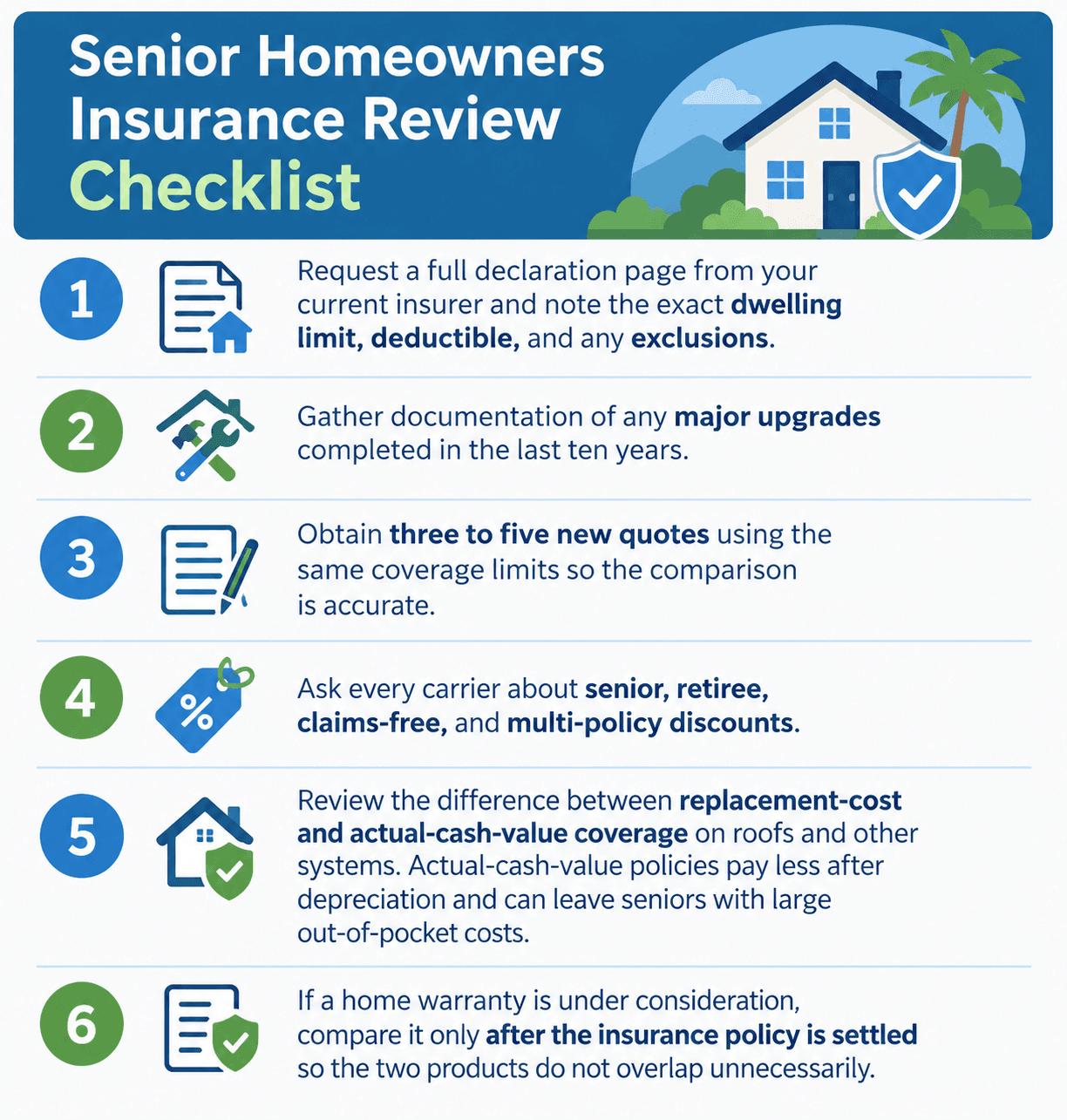
Decision Tool: Rate-Shock Response Checklist
Use this table to decide your next move based on your current situation.
| Situation | Recommended First Step | Potential Savings Source |
|---|---|---|
| Premium rose more than 15% with no claims | Shop 3–5 new quotes immediately | Competitive pricing + discounts |
| Home is older than 30 years with original systems | Document any upgrades; request reclassification | Lower risk tier |
| Considering reverse mortgage or refinance | Secure continuous replacement-cost policy first | Avoid force-placed insurance |
| Budget is tight after the increase | Evaluate home warranty for systems only | Predictable repair costs |
| Already have AARP membership | Request The Hartford AARP quote | Member and bundling discounts |
Other Sagewise Services That Support the Same Goal
Sagewise helps seniors compare options across several related areas that affect the same fixed-income budget. In addition to insurance matching, readers can explore home warranty comparisons, reverse mortgage education, home equity options, and mortgage refinancing resources. Each tool is free, requires no obligation, and is designed with clear language for adults aged 45–70.
Frequently Asked Questions
Why did my homeowners insurance go up even though I filed no claims?
Industry-wide factors such as higher rebuilding costs, regional catastrophe losses, and reinsurance pricing often drive increases that apply to entire books of business. Home age and condition can also push an individual policy higher at renewal.
Do seniors automatically qualify for lower rates?
No. Age itself is rarely a rating factor. Specific retiree or senior discounts exist with some carriers, and AARP members have access to a dedicated program through The Hartford.
Will a new roof lower my premium?
Often yes, once the insurer receives documentation and updates the underwriting file. The same applies to electrical and plumbing upgrades.
What happens if my policy is canceled and I have a reverse mortgage?
The lender can force-place insurance, which is typically far more expensive and provides narrower coverage. Continuous private coverage is required under FHA reverse mortgage rules.
Is flood insurance included in a standard homeowners policy?
No. Flood coverage must be purchased separately through the National Flood Insurance Program or a private flood insurer.
Take the Next Calm Step
Rate increases create real anxiety when the monthly budget is already carefully balanced. The practical response is orderly: gather your current policy details, document any improvements, compare fresh quotes, and claim every discount that applies. Sagewise exists to make that process simpler. Our free matching service connects you with pre-vetted providers so you can see competitive options without obligation or pressure.
Ready to compare homeowners insurance options that fit a senior household?