
Cash-Out Refi vs. HELOC: Which Strategy Protects Your Fixed-Income Cash Flow Better?
From our archive. This guide is being reviewed and updated under our editorial standards. Check figures against the official source before you act.
Sagewise is free to use and may be paid when you click links or submit forms on this page. That never changes what we write. How we make money
You need $40,000. Maybe it’s to pay off high-interest credit cards, help a grandchild with a down payment, or finally finish a necessary home modification. You have $300,000 in home equity, so the money is there, but as a senior on a fixed income, your biggest fear isn’t “debt”—it’s volatility.
You need a monthly bill that is predictable. You cannot afford a “surprise” $300 increase in your housing cost simply because the Federal Reserve decided to hike rates again to fight inflation.
For most seniors, the Cash-Out Refinance is the safer strategy because it provides a fixed interest rate and a guaranteed monthly payment that will never change. While a Home Equity Line of Credit (HELOC) is often cheaper to set up, its variable interest rate makes it a risky “financial gamble” for someone living on a strict Social Security budget. If you need the money for a long-term goal (5+ years), the Refi is your “Financial Bodyguard.” If you only need the money for a quick 12-month bridge, the HELOC might save you on fees.
Key Takeaways
- The Rate Trap: HELOCs have variable rates that can spike; a Cash-Out Refi is fixed for the life of the loan.
- The Cost Comparison: A Refi has high closing costs ($3,000+); a HELOC is nearly free to set up ($0-$500).
- The Amortization Risk: A Refi restarts your 15 or 30-year clock; a HELOC allows for “interest-only” payments for 10 years before a massive “payment shock” hits.
- The Verdict: If you are consolidating debt for the long haul, choose the Refi. If you have a guaranteed way to pay the debt off in 2 years, the HELOC wins.
Unlock your home’s value without the stress. Lower your monthly costs safely.
Side-by-Side: The Stability Showdown
| Feature | Cash-Out Refinance | HELOC (Line of Credit) |
|---|---|---|
| Interest Rate | Fixed (Guaranteed) | Variable (Tied to Prime Rate) |
| Monthly Payment | 100% Predictable | Unstable (Can rise monthly) |
| Upfront Costs | $3,000 - $6,000 (High) | **$0 - $500 (Low)** |
| Repayment Term | 15 or 30 Years | 10-year Draw / 20-year Payback |
| Access to Funds | One-time Lump Sum | Reusable "House ATM" |
| Verdict | Best for "Sleep at Night" | Best for Emergency Safety Net |
The "Payment Shock" Warning: Don't Forget the Reset
If you choose a Cash-Out Refi, you are starting a brand new mortgage. This is a double-edged sword for seniors.
- The Danger: If you have 5 years left on your current mortgage and you refinance into a new 30-year loan to get cash out, you have just extended your debt by 25 years. You might find yourself still paying for your home when you are 95 years old.
- The “Front-Loaded” Interest: New mortgages are “front-loaded,” meaning most of your early payments go toward interest rather than principal.
- The Bodyguard Advice: Try to match the new term to your old one. If you have 12 years left, ask for a 15-year Fixed Refi. Your payment will be higher than a 30-year, but you won’t be passing debt to your heirs for decades.
The "Variable Rate" Reality Check: Why HELOCs Spike
HELOCs are tied to theFederal Prime Rate. When the economy shifts, your bank doesn’t need your permission to raise your rate.
The HELOC Rate Hike
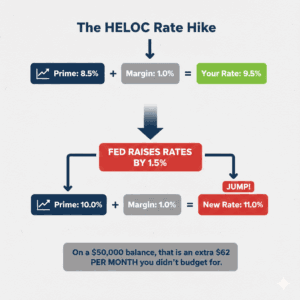
[Prime: 8.5\%] + [Margin: 1.0\%] = [Your Rate: 9.5\%]
*If the Fed raises rates by 1.5% next year, your rate jumps to 11.0%. On a $50,000 balance, that is an extra *$62 per month* you didn’t budget for.*
The "Tax" Myth: Is the Interest Deductible?
Many seniors choose home equity debt because they believe the interest is tax-deductible, providing a “subsidy” for their debt. However, under the Tax Cuts and Jobs Act (TCJA), the rules are far stricter than they were in previous decades.
To be a savvy borrower, you must understand the “Tracing Rule.” The IRS doesn’t care that the loan is secured by your home; they only care where the money actually went.
- Home Improvements (The Only “Yes”): If you use the cash to build an addition, install a new roof, or replace the HVAC, the interest is Deductible. The IRS defines this as a “substantial improvement” that adds value, prolongs life, or adapts the home to new uses.
- Maintenance & Repair (The “No”): Curiously, minor repairs (like fixing a leaky faucet or painting) do not count as “substantial improvements.”
- Debt Consolidation (The Hard “No”): If you use the cash to pay off credit cards, medical bills, or a car, the interest is NOT Deductible.
The Bodyguard Perspective: Even if your repair qualifies, remember that the Standard Deduction for seniors in 2026 is higher than ever. Unless your total itemized deductions (mortgage interest + medical + charity) exceed $33,000+ (for couples), the tax break is functionally worth zero to you. Consult our Senior Tax Deduction Guide to see if itemizing even makes sense for your bracket.
When a HELOC Wins (The "Short-Term" Play)
While we often warn against the volatility of a HELOC, there is one scenario where it is the undisputed champion: The Bridge Financing Play.
If you are facing a temporary cash need with a guaranteed “exit strategy” (meaning you know exactly where the money to pay it off is coming from), the HELOC is the most cost-effective tool in existence.
- Inheritance or Sale: If you are expecting an inheritance or the sale of another property (like a vacation home) within 12 to 24 months, use the HELOC to pay off high-interest credit cards today.
- The “Zero-Fee” Math: A Cash-Out Refi would charge you $5,000 in closing costs on Day 1. If you pay that loan off in 12 months, those fees effectively added 12.5% to your interest rate for that year.
- The Benefit: Since there are virtually no closing costs for a HELOC ($0-$500), you haven’t “wasted” thousands in fees on a loan you only needed for a year. The variable interest rate doesn’t matter much if the debt is gone before the Federal Reserve has time to hike rates again.
- Revolving Flexibility: Unlike a Refi, which is a one-time “dump” of cash, a HELOC is a revolving line. If you pay it back, the money becomes available again. It acts as a “dormant” emergency fund that costs you nothing until you touch it.
Frequently Asked Questions (FAQ)
Can I switch a HELOC to a fixed rate later?
Yes! Many modern lenders (like PNC or BMO) offer a “Fixed-Rate Lock” feature. You can take a draw of $20,000 and “lock it in” at a fixed rate, while the rest of your line stays variable. Always ask your bank if they offer “Lock Options” before you sign.
Which one is harder to qualify for?
The Cash-Out Refi is generally stricter because the bank is handing you a large lump of cash all at once. They will scrutinize yourSocial Security and Pension income more heavily than a HELOC lender might.
Does a Refi affect my "Step-Up" basis for heirs?
No. Neither a Refi nor a HELOC changes the tax status of your home for your children. They will still receive the “Step-Up in Basis” on the home’s value, regardless of how much debt is on it. (Read our guide onInheritance Mistakes for more).
What is the "Break-Even" point for a Refi?
You must stay in the home long enough for the monthly savings to cover the closing costs. If you save $100 a month but paid $4,000 in fees, you must stay in the house for at least 40 months just to break even.
Is a Reverse Mortgage better than both?
If your primary goal is increasing your monthly “spending money” rather than just paying off debt, aReverse Mortgage is often superior because it eliminates the monthly mortgage payment entirely.
Explore Debt Relief Options(Choose the most stable path for your retirement budget today.)
This guide is for general education and isn't individual financial, insurance, legal or tax advice. Spot an error? Tell us and we'll review it under our corrections policy.