
Debt Settlement vs. Debt Management: The Risky Truth for Seniors
From our archive. This guide is being reviewed and updated under our editorial standards. Check figures against the official source before you act.
Sagewise is free to use and may be paid when you click links or submit forms on this page. That never changes what we write. How we make money
If you are struggling with high credit card debt, you have undoubtedly seen advertisements promising to “cut your debt in half!” or “eliminate 50% of your balance!”
These programs fall into two very different categories: Debt Settlement and Debt Management.
One is a safe, reliable path back to financial health. The other is a high-risk gamble that can destroy your credit score, leave you vulnerable to lawsuits, and cost you thousands in hidden fees.
As your trusted advocate, we are here to clarify the crucial difference between these two paths and show you why one is almost always a smarter, safer choice for a senior on a fixed income.
Key Takeaways
- Settlement is a Gamble: Debt Settlement (cutting the principal) is a high-risk, negative option that severely damages your credit score and carries the risk of lawsuits.
- Management is a Plan: Debt Management (lowering the interest rate) is a safer, positive option provided by non-profit credit counselors.
- Credit Score Risk: Settlement destroys your score. Management helps stabilize and repair your score.
- The Golden Rule: Never pay a debt settlement company before they have successfully negotiated a payment for you.
Debt Settlement vs. Debt Management: The Core Comparison
This table quickly highlights the major differences and risks of each approach:
| Feature | Debt Settlement (High-Risk) | Debt Management (Safer Path) |
|---|---|---|
| Goal | Cut the Principal (Pay less than you owe). | Cut the Interest Rate (Pay the full amount over time). |
| Credit Impact | Severe Negative. Credit score drops 100+ points due to missed payments. | Stabilizes/Improves. Accounts are reported as "Paid as Agreed." |
| Lawsuit Risk | HIGH. Creditors often sue when payments stop. | LOW. Creditors are paid consistently, reducing risk. |
| Tax Risk | HIGH. Forgiven debt is usually counted as taxable income (1099-C form). | NONE. No debt is forgiven, so there is no tax liability. |
| Process | Stop payments, save in an escrow account, negotiate. | Consolidate payment, negotiate interest rates, pay counselor monthly fee. |
Option 1: Debt Settlement (The Risky Gamble)
Debt Settlement companies are for-profit businesses that negotiate directly with your creditors to settle a debt for less than the full amount owed (e.g., settling a $10,000 debt for $5,000).
| Debt Settlement | Why It’s High-Risk for Seniors |
|---|---|
| The Process: You stop paying your creditors and send money into a separate escrow account. The settlement company uses this accumulated cash to negotiate a lump-sum payment. | High Lawsuit Risk: Because you stop making payments, you are highly vulnerable to being sued by creditors. |
| Credit Impact: Severe Negative Impact. Your credit report will show a long trail of missed payments and "Settled" accounts, drastically lowering your score for up to seven years. | High Fees Upfront: Fees are often high and are only paid after the negotiation is successful. Many clients pay thousands before a single creditor agrees to settle. |
| Taxes: The amount of debt forgiven (the $5,000 you saved) is generally considered taxable income by the IRS (see tax section below). | No Guarantee: The company cannot guarantee that all your creditors will agree to settle; you could settle some debts and be sued for others. |
The Lawsuit Reality: Garnishments and Judgments
Seniors are often targeted by collectors threatening lawsuits. Here is the legal reality:
- The Lawsuit: A collector can sue you for the debt. If they win, they receive a civil judgment against you.
- The Safety Net: That judgment cannot touch your Social Security check, VA benefits, or 401(k)/IRA retirement funds. Federal law protects these assets (as covered in our guide, Can They Garnish My Social Security?).
- The Collector’s Calculation: Most collectors know that seniors on fixed incomes have legally protected assets. Forcing a lawsuit is expensive and time-consuming. Because there is little left for them to seize, many collectors choose not to sue seniors with unsecured debt.
Option 2: Debt Management (The Safe, Structured Plan)
A Debt Management Plan (DMP) is a safer, more structured option offered by non-profit credit counseling agencies. These plans do not try to cut the principal. Instead, they focus on getting creditors to lower or eliminate your interest rates and waive fees.
| Debt Management | Why It’s the Safer Choice for Seniors |
|---|---|
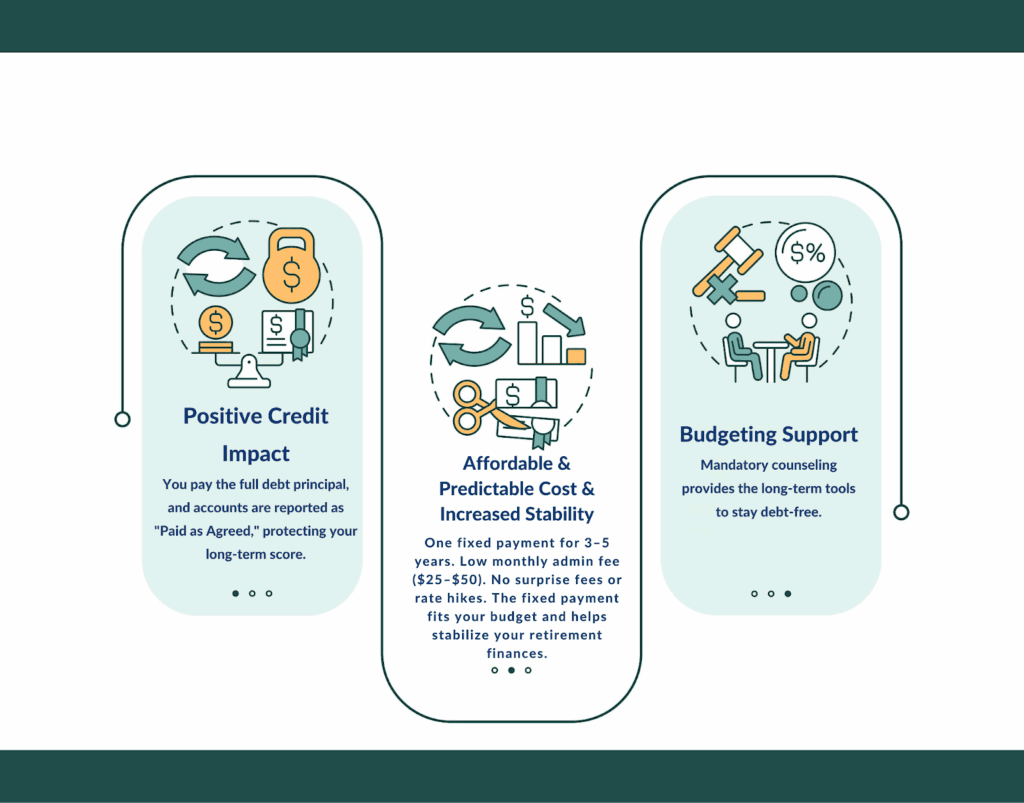
| LightStream The Process: The agency works with you to create one consolidated monthly payment. They negotiate lower interest rates (e.g., from 25% down to 5-10%) and get creditors to stop late fees. | Positive Credit Impact: You continue to make payments, so there is no immediate negative hit to your credit score. Accounts are reported as "Managed" or "Paid as Agreed." |
| Cost: Low fees, usually a modest monthly administrative fee (e.g., $25–$50), and often minimal setup fees. | Stability: You have one fixed, predictable payment that fits your budget. Payments are usually completed in 3-5 years. |
| Control: Creditors usually stop collection calls because they see you are committed to paying the full amount. | Budgeting Support: The agency provides mandatory budget counseling and financial education, helping you get out of debt for good by building better habits. |
The Critical Tax Problem: The 1099-C Shock
This is the hidden cost of Debt Settlement. When a creditor forgives more than $600 of your debt, they are required to send you and the IRS a Form 1099-C (Cancellation of Debt).
- The Tax Trap: The amount of debt forgiven (the portion you didn’t pay) is treated by the IRS as taxable income. This can push you into a higher tax bracket and generate a huge surprise tax bill.
- The Solvable Exception (Insolvency): If your total liabilities (debts) were greater than your total assets (savings, home equity) at the time of settlement, you may qualify for the Insolvency Exception. This highly complex IRS rule can exempt you from paying tax on the canceled debt. If you choose settlement, you must immediately consult a CPA about filing for this exception.
Action Plan: How to Deal with Debt Collectors
Don’t let fear force you into a bad payment plan. Know your rights.
- Request Verification (Your Right): When a collector calls, never admit the debt is yours. Demand verification of the debt in writing. Do not pay anything until you have this documentation.
- End the Calls (FDCPA Power): The Fair Debt Collection Practices Act (FDCPA) is a federal law that makes collector harassment illegal. Sending a certified letter demanding all future contact be in writing forces them to comply.
Frequently Asked Questions (FAQ)
Is the interest on a debt consolidation loan tax-deductible?
Interest on a Personal Loan is never tax-deductible. Interest on a HELOC is only deductible if the funds were used for qualified home improvement expenses, not debt consolidation.
Which option is fastest to get approved for?
A Balance Transfer Credit Card is the fastest, often approved in minutes. A Personal Loan can be approved in 1-7 days. A HELOC is the slowest, typically taking 3-6 weeks because it requires a home appraisal.
Does debt consolidation hurt my credit score?
A debt consolidation loan itself can temporarily lower your score because you are applying for new credit. However, by paying off high-interest, revolving credit card debt, you immediately lower your credit utilization ratio, which often causes your credit score to rise significantly within a few months.
What is the greatest risk of a HELOC?
The greatest risk is the variable interest rate and the foreclosure risk. If your rate doubles and you cannot make the payment, you risk losing your home, as the loan is secured by your property.
How do I avoid the Balance Transfer Trap?
Use the card only for the balance transfer. Pay it off aggressively. Before the promotional period ends, make sure the balance is zero to avoid the immediate jump to a very high interest rate.
This guide is for general education and isn't individual financial, insurance, legal or tax advice. Spot an error? Tell us and we'll review it under our corrections policy.