
The Refi Break-Even Test: Is Saving 1% Worth $5,000 in Fees at Age 75?
From our archive. This guide is being reviewed and updated under our editorial standards. Check figures against the official source before you act.
Sagewise is free to use and may be paid when you click links or submit forms on this page. That never changes what we write. How we make money
If interest rates drop even slightly, mortgage lenders will start calling you. They’ll promise to “Lower your rate by 1%!” and save you hundreds of dollars a month. For a senior on a fixed income, $200 back in your pocket sounds like a miracle—a way to fight inflation or cover risingMedicare Part B premiums.
But for a retiree, the interest rate isn’t the most important number. The most important number is the Break-Even Point.
Refinancing is only a winning strategy if the Monthly Savings will pay back the Closing Costs within 24 to 36 months. At age 75, your “time horizon” is shorter than a 30-year-old’s. If the math shows it takes 5 years to break even, and there’s a chance you might downsize, move to assisted living, or pass away before then, the bank is the only one winning. Refinancing is not free; it typically costs $3,000 to $6,000 in appraisal fees, title insurance, and taxes. If you pay $5,000 to save $100 a month, you have actually lost $1,400 if you move in three years.
As your trusted advocate, we are here to act as your financial bodyguard. We will show you the simple math to see if a refi is a gift or a trap for your 2026 budget.
Key Takeaways
- The Golden Rule: Only refinance if you plan to stay in the home longer than it takes to recover the upfront costs.
- The “Reset” Trap: Beware of resetting a 15-year mortgage back to 30 years; it lowers your payment but triples your total interest.
- The 1% Threshold: Most experts suggest a rate drop of at least 0.75% to 1% is needed to justify the administrative fees.
- The Alternative: If you just want a lower payment without the fees, ask about a Mortgage Recast.
Don’t pay thousands in fees without a plan. Lower your monthly costs safely.
The Anatomy of Closing Costs: What are you paying for?
Seniors are often shocked to see a $5,000 bill for “paperwork.” Lenders are required by the Consumer Financial Protection Bureau (CFPB) to give you a Loan Estimate within three days of your application. Here is where that money actually goes:
| Fee Type | Typical Cost | Why Seniors Pay It |
|---|---|---|
| Appraisal Fee | $500 - $700 | The bank must verify your home hasn't lost value since you retired. |
| Title Insurance | $1,000 - $2,000 | Protects the lender (and you) against old liens or ownership disputes. |
| Origination Fee | 0.5% - 1.0% of loan | The "commission" the bank takes for processing the new loan. |
| Credit Report Fee | $50 - $100 | Verifying your senior credit score hasn't dipped. |
| Recording Fees | $100 - $300 | Paid to the county to update the deed records. |
The Bodyguard Warning: If a lender says there are “Zero Closing Costs,” they are likely rolling that $5,000 into your loan balance. You are still paying it—with interest—for the next 30 years.
The Break-Even Math Table
Use this table to find your “Danger Zone.” If your scenario falls in the bottom row, hang up the phone on that lender.
| Closing Costs | Monthly Savings | Months to Break Even | Bodyguard Verdict |
|---|---|---|---|
| $4,000 | $200 | 20 Months | SAFE (Great Move) |
| $4,000 | $100 | 40 Months | CAUTION (Only if staying 5+ yrs) |
| $6,000 | $80 | 75 Months | DANGER (The Bank Wins) |
The Payoff Horizon
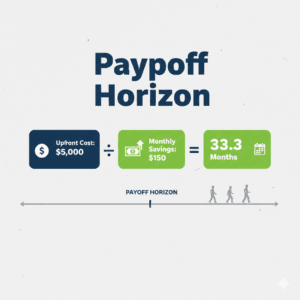
In this example, every month you stay in the house AFTER Month 34 is “pure profit.” Every month you leave BEFORE Month 34 is a “net loss.”
Retirement Stress Test
Will the new mortgage payment help or hurt your long-term stability? Use our Retirement Stress Testto see how your cash flow changes after accounting for the upfront fees and the new monthly bill.
The 15-Year vs. 30-Year Choice: The "End Date" Reality
If you are 70, do you really want a 30-year mortgage that doesn’t end until you are 100?
- The 30-Year: Offers the lowest monthly payment. This is the best choice if your only goal is maximizing your monthly Social Security check for daily living.
- The 15-Year: Offers a higher monthly payment but a much lower interest rate. You will save tens of thousands in interest and actually own the home free-and-clear while you are still active.
Bodyguard Tip: If you can afford the higher payment, the 15-year is the “Wealth Builder.” If your budget is tight, the 30-year is your “Safety Valve.”
Strategic Alternatives for Seniors
Before you commit to a full refinance, consider these two senior-specific tools:
- Mortgage Recasting: If you have a lump sum of cash (e.g., from an RMD or inheritance), you can pay down your balance and ask the bank to “re-amortize” your payment. This lowers your monthly bill for a flat fee of ~$250, without the $5,000 refi cost.
- Reverse Mortgage (HECM): If you are age 62+ and your primary goal is eliminating the mortgage payment entirely to increase your lifestyle, a Reverse Mortgage is often superior to a refinance.
Frequently Asked Questions (FAQ)
Can I refinance on Social Security alone?
Yes. Lenders use a “Gross-Up” method where they count your tax-free Social Security income as being worth 125% of its value to help you meet their debt-to-income requirements.
Will my credit score drop?
Initially, yes. The lender performs a “Hard Inquiry,” which usually drops your score by 5-10 points. However, if the lower payment reduces your overall debt-to-income ratio, your score will typically bounce back and potentially even rise within 6 months.
Does refinancing affect my property taxes?
Generally, no. A mortgage refinance is a change in the debt on the property, not a change in the ownership or assessment. However, some states trigger a re-assessment on any title change, so check with your local assessor’s office first.
Can I get a "Cash-Out" Refi to pay medical bills?
Yes. This is a common move for seniors. However, remember that you are turning “unsecured” medical debt into “secured” home debt. If you miss payments, you risk foreclosure. A Personal Loan for Consolidation might be safer.
How long does the process take?
Expect a refinance to take 30 to 45 days. You will need to provide your SSA-1099and pension statements to prove your retirement income stability.
Explore Debt Relief Options(Find the right path to a lower mortgage and a more secure retirement today.)
This guide is for general education and isn't individual financial, insurance, legal or tax advice. Spot an error? Tell us and we'll review it under our corrections policy.