
Joint Tenancy, Life Estates & Home-Equity Access: Ownership Structures That Help or Hurt Seniors
From our archive. This guide is being reviewed and updated under our editorial standards. Check figures against the official source before you act.
Sagewise is free to use and may be paid when you click links or submit forms on this page. That never changes what we write. How we make money
The way a home is titled can quietly help or block access to equity. Joint tenancy, tenancy in common, life estates, and trusts each carry different rules for who must sign loan documents, who can remain in the home, and how quickly a sale can close. For seniors exploring a reverse mortgage, HELOC, or future sale, the current deed structure is one of the first items a lender or title company will examine.
This guide explains the most common ownership forms in plain language, shows how each one interacts with home-equity products, and outlines simple steps that can clear obstacles before an application begins.
Key Takeaways
- Joint tenancy with right of survivorship usually allows the surviving owner to take full title without probate, yet every owner typically must qualify and sign for a new loan.
- A life estate gives the life tenant the right to live in the home for life while the remaining interest belongs to someone else; both parties often need to consent to a reverse mortgage or sale.
- Incorrect or outdated titling is one of the most common reasons reverse-mortgage or HELOC applications stall.
- Many title issues can be corrected with a new deed before applying for financing.
- Clear ownership simplifies both equity access now and estate settlement later.
Why Title Structure Matters for Equity Access
Lenders need clear authority to place a lien on the property. If the people who must sign are not the same as the people listed on the deed, or if a remaining interest is held by someone who cannot be located, the transaction stops. Title companies also require a clean chain of ownership before they will insure a new mortgage or a sale.
For seniors the stakes are practical. A reverse mortgage can supply tax-free cash without a monthly mortgage payment. A HELOC can provide a flexible safety net. Both products become harder or impossible if the deed does not match the people who need to borrow.
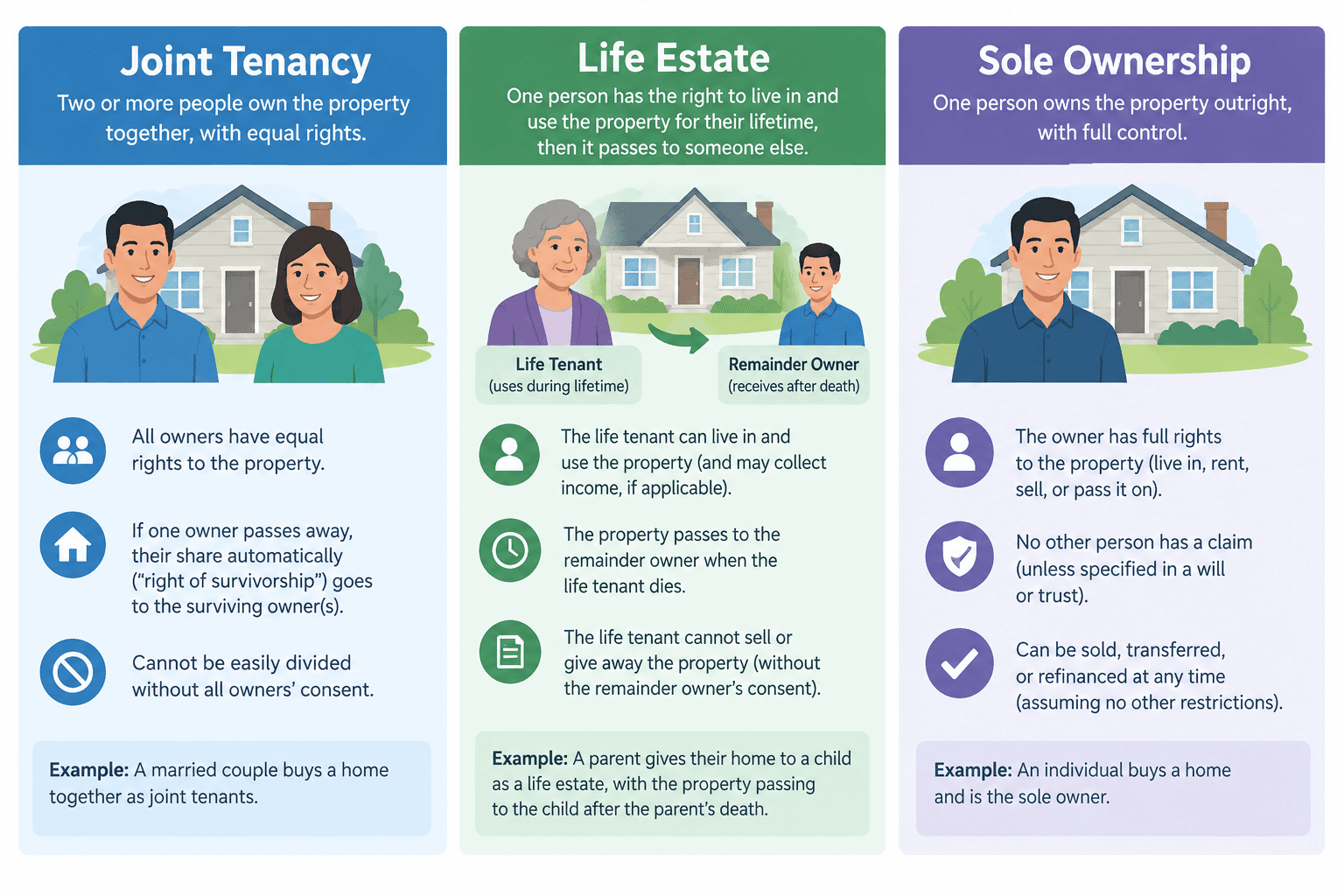
Joint Tenancy with Right of Survivorship
This is one of the most common ways married couples and some family members hold title. When one owner dies, the surviving owner automatically receives full ownership without probate.
Advantages for seniors:
- Avoids probate on the first death
- Keeps the home available to the surviving spouse or partner
Points to watch:
- Every joint tenant usually must apply and qualify for a reverse mortgage or HELOC
- If one joint tenant is under age 62, a reverse mortgage may be limited or structured with that person as a non-borrowing spouse (subject to current HUD rules)
- Adding or removing a joint tenant requires a new deed and may have gift-tax or Medicaid look-back implications
Tenancy in Common
Each owner holds a distinct percentage interest. There is no automatic right of survivorship. When one owner dies, that share passes according to the will or state law.
This structure is less common for primary residences of married seniors but appears when siblings inherit together or when an unrelated co-owner is added. Lenders generally require all tenants in common to sign mortgage documents. Selling or refinancing therefore needs everyone’s cooperation.
Life Estates
A life estate splits ownership into two parts. The life tenant has the right to live in and use the home for the rest of their life. The remainderman (or remaindermen) owns the future interest that becomes full ownership when the life tenant dies.
Life estates are sometimes created to keep the home in the family or to support Medicaid planning. For equity access they create extra steps:
- A reverse mortgage usually requires the remainderman to sign or consent
- A sale requires agreement from both the life tenant and the remainderman
- HELOC lenders also typically insist on signatures from all parties with an ownership interest
If the remainderman is unwilling or difficult to locate, the transaction can stall indefinitely. Some families choose to terminate the life estate and retitle the property in the life tenant’s name alone before applying for financing, provided Medicaid or other planning goals allow it.
Trust Ownership
Homes held in a revocable living trust are generally eligible for reverse mortgages and HELOCs if the trust meets lender and FHA guidelines. The borrower must be the beneficiary with the right to occupy the home, and the trust document must give the trustee clear authority to mortgage the property. Lenders will request a copy of the trust (or a certificate of trust) for review.
Irrevocable trusts are more restrictive and often prevent a reverse mortgage unless specific exceptions apply. Early review of the trust language avoids wasted application fees.
Simple Fixes Before You Apply
- Request a current copy of the recorded deed from the county recorder or a title company.
- Confirm that every person who needs to borrow or remain in the home is correctly listed.
- If a life estate or extra joint tenant is creating obstacles, ask an elder-law or real-estate attorney whether a new deed can simplify ownership without unwanted tax or Medicaid consequences.
- For trust-owned homes, gather the trust document or certificate of trust early so the lender can complete its review.
- Allow extra time if any owner lives out of state or needs a power of attorney.
Ownership Structure Comparison
| Ownership Form | Survivorship Feature | Who Must Sign for Reverse Mortgage / HELOC | Typical Ease of Future Sale | Common Senior Use Case |
|---|---|---|---|---|
| Sole ownership | None | Only the owner | Highest | Single senior or widowed owner |
| Joint tenancy | Automatic to survivor | All joint tenants | High once all sign | Married couples |
| Tenancy in common | None (passes by will) | All co-owners | Depends on cooperation | Inherited shares among siblings |
| Life estate | Life tenant’s right ends at death | Life tenant + remainderman | Lower (needs both parties) | Family property-transfer planning |
| Revocable trust | Controlled by trust terms | Trustee with proper authority | High if trust is well drafted | Probate avoidance |
Tools That Clarify the Bigger Picture
Before changing a deed or applying for financing, several free tools on Sagewise can help quantify the financial effect:
- Home Equity “Cash Unlock” Calculator – Estimates potential proceeds once title is clear.
- Aging-in-Place Budgeter – Shows how access to equity changes the long-term cost of remaining in the home.
- Home Transition Analyzer – Useful if ownership complexity is prompting thoughts of a sale instead of a loan.
- Mortgage-Free Planner – Illustrates cash-flow changes after a reverse mortgage pays off an existing loan.
Running one of these tools supplies concrete numbers you can discuss with family or an attorney.
Other Sagewise Services That Support Next Steps
Sagewise is an independent comparison and matching service. It does not prepare deeds or give legal advice. After title questions are resolved, you can explore related options through the free matching process, including reverse-mortgage and HELOC offers that fit senior underwriting, or cash-for-homes programs if a sale becomes the clearer path.
Frequently Asked Questions
Can I add an adult child to the deed and still get a reverse mortgage?
Adding a child as a joint tenant usually means that child must also be at least 62 and must qualify as a borrower, or the transaction may be structured with the child as a non-borrowing owner under strict limits. Many families instead keep the senior as sole owner or use a trust.
Does a life estate protect the home from Medicaid estate recovery?
Rules vary by state. A properly created life estate can sometimes limit recovery, yet it also complicates equity access. Consult an elder-law attorney before relying on this strategy.
How long does it take to correct a title issue?
A simple corrective deed can often be prepared and recorded in a few weeks. More complex changes involving trusts or multiple remaindermen take longer. Start early.
Will changing the deed trigger a property-tax reassessment?
Many states offer exclusions for transfers between spouses or into certain trusts. Check local rules or ask a title professional before recording a new deed.
Closing Perspective
The deed is more than a formality. It determines who can borrow against the home, who can stay after one owner dies, and how quickly a sale can close. Reviewing the current ownership structure before applying for a reverse mortgage or HELOC prevents most title-related delays.
If the existing arrangement no longer matches your goals, a straightforward deed change is often possible. Once the title is clear, equity products and future sale options become far simpler to execute.
Want to estimate available equity once the title is sorted?
Check our Tools and try the Home Equity “Cash Unlock” Calculator or Aging-in-Place Budgeter. When you are ready for personalized lender information, the free matching service is available with no obligation. Move forward only when the ownership picture and the numbers both feel right.
This guide is for general education and isn't individual financial, insurance, legal or tax advice. Spot an error? Tell us and we'll review it under our corrections policy.