
What Happens to Your Home Warranty If You Move into Assisted Living or Sell the House?
From our archive. This guide is being reviewed and updated under our editorial standards. Check figures against the official source before you act.
Sagewise is free to use and may be paid when you click links or submit forms on this page. That never changes what we write. How we make money
Many of us reach a point where the house that has been home for decades starts to feel like more work than comfort. Systems that once ran quietly now need more attention. At the same time, your own needs may be changing. Whether you are considering a move to assisted living or preparing to sell so you can simplify, questions about ongoing coverage come up quickly. One of the most practical is what happens to an existing home warranty.
A home warranty is a service contract that helps cover the cost of repairing or replacing certain home systems and appliances when they fail from normal wear. It is separate from homeowners insurance. Understanding how that contract behaves during a life transition can remove one source of uncertainty at a time when clarity matters most.
Key Takeaways
- Most home warranties are tied to the property and can often be transferred to a new owner when you sell.
- If you move to assisted living without selling right away, you can usually cancel the plan and request a prorated refund of unused premiums.
- Transfer rules, fees, and refund calculations vary by company and state. Always check your specific contract.
- Reviewing coverage options early helps protect a fixed income from unexpected repair bills during the transition period.
- Free, no-obligation matching services can help compare providers if you decide to keep or replace coverage.
Why These Questions Surface at This Stage of Life
Homes age just as people do. Major systems such as heating and cooling, plumbing, and electrical components have finite lifespans. According to research from the Joint Center for Housing Studies at Harvard, older homes often require higher spending on maintenance and repairs. For households on fixed or semi-fixed incomes, a sudden HVAC failure or water heater replacement can create real strain.
AARP has long documented that the large majority of adults over 50 prefer to remain in their current homes as they age. When that is no longer practical, the decision to sell or move into assisted living brings practical details into focus. A home warranty may still have months left on the contract. Knowing whether it can travel with the property, be canceled cleanly, or leave you with leftover costs helps you plan without surprises.
Consumer Reports advises homeowners to read the full contract before relying on any plan. Coverage limits, exclusions for pre-existing conditions, and service fees all affect the real value. Those same details become especially important when ownership or occupancy is about to change.
What Typically Happens When You Sell the House
In most cases a home warranty can be transferred to the buyer. The coverage is linked to the property address rather than solely to the original policyholder. Many providers allow the remaining term to continue under the new owner’s name once the transfer is completed.
The process is rarely automatic. You or your real estate agent usually need to notify the warranty company in writing, provide the closing date, and share the buyer’s contact information. Some companies charge a modest administrative fee, often in the range of $25 to $50, though amounts vary. A few states, such as Florida, set specific rules and caps on transfer fees for home warranty contracts.
Transferring an active plan can make the home more attractive to buyers. It signals that major systems have some protection during the first months of ownership. If the existing plan is near its end date, some sellers choose instead to purchase a new one-year plan that begins at closing as a concession. Either approach is negotiable between buyer and seller.
If the contract does not allow transfer, or if the buyer declines it, you can cancel. Most companies provide a prorated refund of the unused portion of the premium after subtracting any claims already paid and, in some cases, a small cancellation fee. The exact calculation appears in the cancellation section of your agreement.
What Happens If You Move into Assisted Living
Moving into assisted living does not automatically cancel a home warranty. As long as you still own the property and the plan remains active, coverage continues. If the house will sit vacant or be occupied by family members for a period, you may decide the monthly or annual cost is no longer useful.
Cancellation is usually straightforward. Contact the provider, state that you are relocating, and request termination. Refunds follow the same pro-rata rules that apply when a home is sold. Some contracts allow cancellation without penalty if you are purchasing a new home warranty at a different address, though this is less common when the next residence is a facility rather than another single-family home.
If adult children will maintain the property for a time, they may choose to keep the existing plan or switch to a different level of coverage. Clear communication with the warranty company about the change in primary residence helps avoid claim complications later.
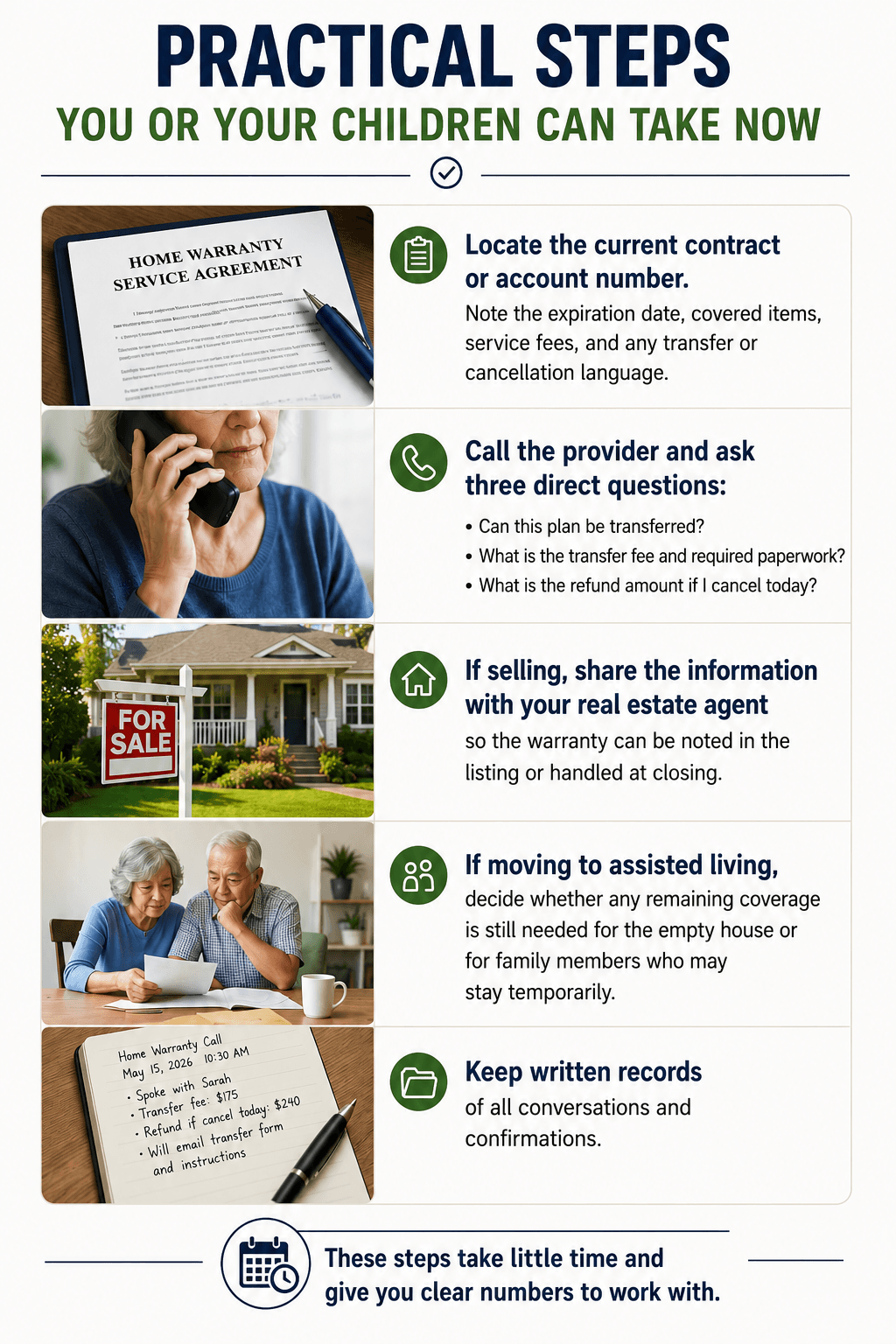
Simple Decision Checklist
Use this checklist to decide the best path for your situation:
- Do I still own the property and expect to sell it within the next several months? → Consider transferring the remaining term to the buyer.
- Will the house sit vacant or be lightly occupied after I move? → Weigh the monthly cost against the chance of a covered repair.
- Is the plan near its renewal date? → Compare the cost of renewing versus letting it lapse or buying a short-term seller’s plan.
- Have I already used the warranty for major claims this term? → Factor any remaining limits into the decision.
- Do the service fees and exclusions still make sense for my budget? → If not, cancellation may free funds for other transition costs.
If the answers point toward new coverage later, or if you simply want a clear comparison of current options, a free matching process can show what pre-vetted providers offer for seniors in similar situations.
Common Questions About Home Warranties During a Move or Sale
Can the home warranty be transferred to the person who buys my house?
Yes, in most cases. The plan is usually tied to the property, not just to you. You will need to contact the company, provide the closing details, and complete any required paperwork. A small transfer fee sometimes applies. Confirm the exact steps in your contract so there is no gap in coverage for the buyer.
What if I move into assisted living but do not sell the house right away?
The warranty stays active as long as you own the property and keep paying the premium. If the house will be empty or used only occasionally by family, you can cancel and ask for a prorated refund of the unused portion. Some plans continue to cover systems even when the home is vacant, but it is wise to verify this with the provider.
Will I get money back if I cancel the plan?
Most companies refund the unused premium on a pro-rata basis after any claims already paid and, in some cases, a modest cancellation fee. The exact amount depends on how much time is left on the contract and the terms written in your agreement. Ask for the calculation in writing before you decide.
Does coverage continue while the house is empty?
It often does, provided the plan remains paid and active. However, some contracts have rules about vacant properties or require notice if no one is living there full-time. A quick call to the company clears this up and prevents claim problems later.
Should I buy a new warranty for the buyer instead of transferring the old one?
That is a common choice, especially if your current plan is close to expiring. Offering a fresh one-year plan that starts at closing can make the home more appealing and give the buyer a full term of protection. Whether you transfer the remaining coverage or purchase a new plan is something you can discuss with your agent and the buyer.
How do I find out the exact rules for my specific plan?
Start with the contract itself. Then call the customer service number on your account and ask about transfer, cancellation, and refund details. Write down the date, the name of the representative, and what they tell you. Having that information in hand makes the next steps simpler for you or your adult children.
Looking Beyond the Current Warranty
Sagewise helps older adults and their families compare home protection options without pressure. The same independent matching approach is available for related needs that often arise during these transitions, including homeowners insurance reviews, options for covering major systems in a new residence, and other financial tools that support fixed-income planning. The goal is straightforward information so you can choose what fits your next chapter.
A home warranty is one piece of a larger picture. Understanding its rules during a move or sale keeps that piece from becoming a source of last-minute stress. By checking the contract, asking direct questions, and deciding based on your actual timeline and budget, you keep control of the process. Peace of mind comes from knowing the next steps rather than guessing what might happen.
If you would like to see current options side by side, Sagewise can connect you with providers who understand the needs of seniors and their families. There is no obligation and no hard sell—just clear information to help you decide.
This guide is for general education and isn't individual financial, insurance, legal or tax advice. Spot an error? Tell us and we'll review it under our corrections policy.