
The Roadside Assistance Audit: AAA vs. Insurance Add-ons—Which Provides the Fastest Rescue?
From our archive. This guide is being reviewed and updated under our editorial standards. Check figures against the official source before you act.
Sagewise is free to use and may be paid when you click links or submit forms on this page. That never changes what we write. How we make money
It is every driver’s nightmare: your engine sputters and dies on a busy freeway, or you walk out to the driveway to find a flat tire just as you’re supposed to leave for a doctor’s appointment. In that moment of vulnerability, you aren’t thinking about “premiums” or “deductibles.” You just want help, and you want it fast.
Most seniors have two options for this “Safety Net”: they either pay for a membership like AAA (American Automobile Association) or they add “Roadside Assistance” to their existing auto insurance policy for a few dollars a month.
On the surface, the insurance add-on seems like the winner. It costs about $15 a year, while AAA can cost $60 to $120.
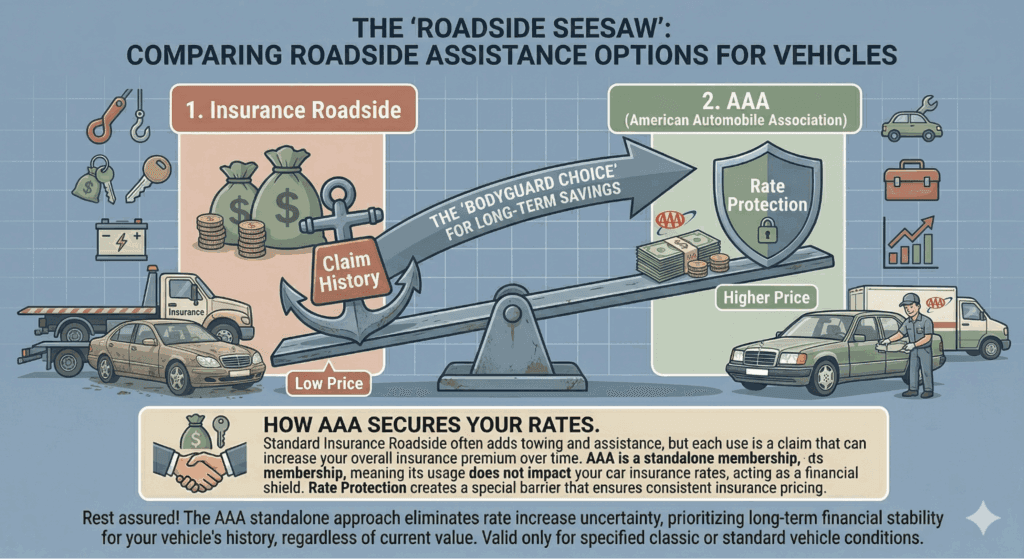
But here is the sageWISE Warning: Using your insurance company’s roadside assistance is often treated as a “Small Claim” on your permanent record.
If you use your insurance for three tows or jump-starts in a year, the company may view you as a “high-frequency claimant,” which can trigger a 20% rate hike or even a non-renewal notice. As your trusted advocate, we have performed a Sagewise Audit of the roadside assistance landscape. We will show you the math of the “Claim Trap,” compare response times, and help you decide which shield actually protects your wallet and your safety in 2026.
Key Takeaways
- The Claim Record Trap: Every time you call your insurer for a tow, a “$0 Claim” is often entered into the CLUE Report database, which other insurers can see.
- Response Time Reality: Most insurance companies and AAA use the same local towing companies. The “Fastest Rescue” depends on who has the better dispatch technology.
- The Membership Edge: AAA and similar clubs offer perks—like DMV services, travel discounts, and maps—that an insurance add-on does not.
- The sageWISE Tip: If you have an older car that breaks down frequently, avoid insurance-based roadside assistance at all costs to protect your claims history.
Stop paying for a “Safety Net” that could hike your rates. See if you are overpaying for your total insurance package today.
Check Your New Senior Rate Now
The sageWISE Audit: AAA vs. Insurance Add-on
To be your own financial bodyguard, you must understand that these two products serve different masters. One is a service club; the other is a risk-mitigation tool for a multi-billion dollar bank.
1. The Insurance Add-on (The Low-Cost Convenience)
Companies like State Farm, Geico, and Progressive offer “Roadside” as an endorsement.
- The Cost: Typically $10 to $20 per year per vehicle.
- The Benefit: It’s incredibly cheap and billed alongside your regular premium.
- The Danger: As we noted in our Claim or Cash? guide, insurers track “frequency.” Even a request for a battery jump-start is recorded. If you are shopping for a new rate through an Independent Broker next year, the new company will see those “roadside events” and may deny you their best “Preferred” tier.
2. AAA / Motor Clubs (The Independent Shield)
AAA is a private organization that exists separately from your insurance company.
- The Cost: $60 to $160 per year (Classic, Plus, or Premier tiers).
- The Benefit: Total anonymity from your insurance company. If you have five flat tires in one year, your insurance premium remains exactly the same.
- The “Senior Concierge” Perks: AAA provides more than just towing. They offer battery testing (and on-the-spot replacement), lockout services, and free maps. For many seniors, the ability to go to a local AAA office to handle DMV paperwork (registration renewals, etc.) is worth the annual fee alone.
The Math: Is the $100 AAA Membership a "Good Deal"?
Let’s look at the “ROI” (Return on Investment) for a senior who uses roadside assistance once a year.
Scenario: A 10-mile Tow.
| Feature | Insurance Add-on Path | AAA Plus Path |
|---|---|---|
| Annual Cost | $15 | $95 |
| The "Event" (Tow) | $0 (Included) | $0 (Included) |
| Hidden Impact | Rate hike of 15% for 3 years | **$0.00 Impact on Rate** |
| Avg. Senior Premium | $1,800 | $1,800 |
| 3-Year Total Cost | **$2,865** (Includes $810 in hikes) | **$2,085** (Membership x 3) |
The Audit Result: By choosing the “cheaper” insurance add-on and using it just once, this senior actually lost $780 over three years. The AAA membership, while more expensive upfront, acted as a “Financial Shield” that protected the senior’s low insurance tier.
The "Fastest Rescue" Factor: Who Dispatches Better?
Response time is the #1 concern for seniors stranded at night. We have audited the dispatch systems for 2026.
- The Reality of Local Networks: Neither AAA nor your insurance company owns a fleet of thousands of tow trucks. They both contract with the same local, mom-and-pop towing companies in your town.
- The “Agero” Monopoly: Most insurance companies outsource their roadside dispatching to a company called Agero. Agero is efficient, but they prioritize the lowest possible cost for the insurer.
- The AAA Advantage: Because AAA is a membership club, they have strict “Service Level Agreements” (SLAs) with their towers. In most metro areas, AAA towers are required to respond within a specific window (often 45-60 minutes) or face penalties.
The “Tracking” Tech: In 2026, both options usually offer a smartphone app that lets you see the tow truck’s location on a map in real-time. This is a critical safety feature for seniors, as it removes the “uncertainty” of sitting in a dark parking lot.
3 Roadside Traps to Avoid
1. The "Mileage Cap" Trap
Basic insurance roadside often only pays for a tow to the nearest repair shop. If that shop is a low-quality garage and you want to go to your trusted mechanic 10 miles further away, you will have to pay out of pocket. AAA Plus and Premier tiers offer 100 to 200 miles of free towing, giving you the freedom to choose your repair destination.
2. The "Lockout" Limitation
Insurance roadside often covers the service call for a lockout but not the cost of a new key. With modern “Smart Keys” costing $300+, this is a major gap. Check if your motor club provides a “Locksmith Credit” (often $100-$150) as part of your membership.
3. The "Unattended" Problem
Some insurers require you to stay with the vehicle until the tow truck arrives. For a senior in extreme heat or cold, this is a health risk. AAA often allows for “Unattended Towing” in safe areas, where you can leave the keys in a hidden spot and go home while they handle the move.
Frequently Asked Questions (FAQ)
1. Does my new car warranty include roadside?
No. Many seniors use AARP Roadside Assistance (managed by Allstate but independent of your policy) or Better World Club, which is a “green” alternative that also covers bicycle breakdowns.
2. Is AAA the only motor club?
No. Many seniors use AARP Roadside Assistance (managed by Allstate but independent of your policy) or Better World Club, which is a “green” alternative that also covers bicycle breakdowns.
3. Does my credit card offer free towing?
Some “Premium” cards (like the Chase Sapphire Reserve or Amex Platinum) offer a “Roadside Dispatch” service. However, be careful: they usually charge a flat fee (around $60-$80) per call. It’s not “free” towing; it’s “pre-negotiated” towing.
4. What if I am a "Snowbird"?
As we noted in our Snowbird Guide, AAA memberships are portable. If you have a membership in Michigan, it works perfectly in Florida. Your insurance roadside also travels, but the “Claim Record” risk follows you across state lines.
5. How many service calls can I make?
AAA Classic typically limits you to 4 service calls per year. Most insurance policies don’t have a hard limit, but making more than two calls in a 3-year period is a major red flag for underwriters.
Check Your New Senior Rate Now(Protect your car. Protect your record. Stay safe on the road today.)
This guide is for general education and isn't individual financial, insurance, legal or tax advice. Spot an error? Tell us and we'll review it under our corrections policy.