
Senior Property Tax Relief Programs: Freezes, Deferrals and How They Interact with a Reverse Mortgage
From our archive. This guide is being reviewed and updated under our editorial standards. Check figures against the official source before you act.
Sagewise is free to use and may be paid when you click links or submit forms on this page. That never changes what we write. How we make money
Property taxes do not stop when paychecks become fixed. For many adults between 45 and 70, the annual tax bill on the family home has become one of the largest and least flexible expenses. At the same time, a reverse mortgage can free cash from home equity without monthly loan payments. The two tools can work together, but only if the property tax rules are understood clearly.
This guide explains the main types of senior property tax relief available across the United States, how those programs affect a reverse mortgage, and the practical steps you can take right now.
Key Takeaways
- Most states offer some form of property tax relief for older homeowners, including freezes, deferrals, exemptions, or circuit-breaker credits.
- A reverse mortgage still requires you to pay property taxes on time. Falling behind can put the loan into default.
- Many deferral programs require written approval from the reverse mortgage lender before taxes can be postponed.
- Relief programs vary widely by state and sometimes by county. Eligibility often depends on age, income, and home value.
- Checking your state’s options costs nothing and can protect both your cash flow and your ability to stay in the home.
Why Property Taxes Feel Heavier in Retirement
When income is limited to Social Security, a pension, or modest withdrawals, a rising property tax bill can force difficult choices. Some seniors delay needed home repairs. Others consider selling sooner than they planned. A reverse mortgage can ease monthly cash-flow pressure by eliminating the traditional mortgage payment, yet the obligation to pay property taxes remains.
HUD rules for Home Equity Conversion Mortgages (HECMs) require borrowers to keep property taxes current. If taxes go unpaid, the lender may advance the money and then declare a technical default. Understanding available relief programs is therefore a practical step for anyone considering or already holding a reverse mortgage.
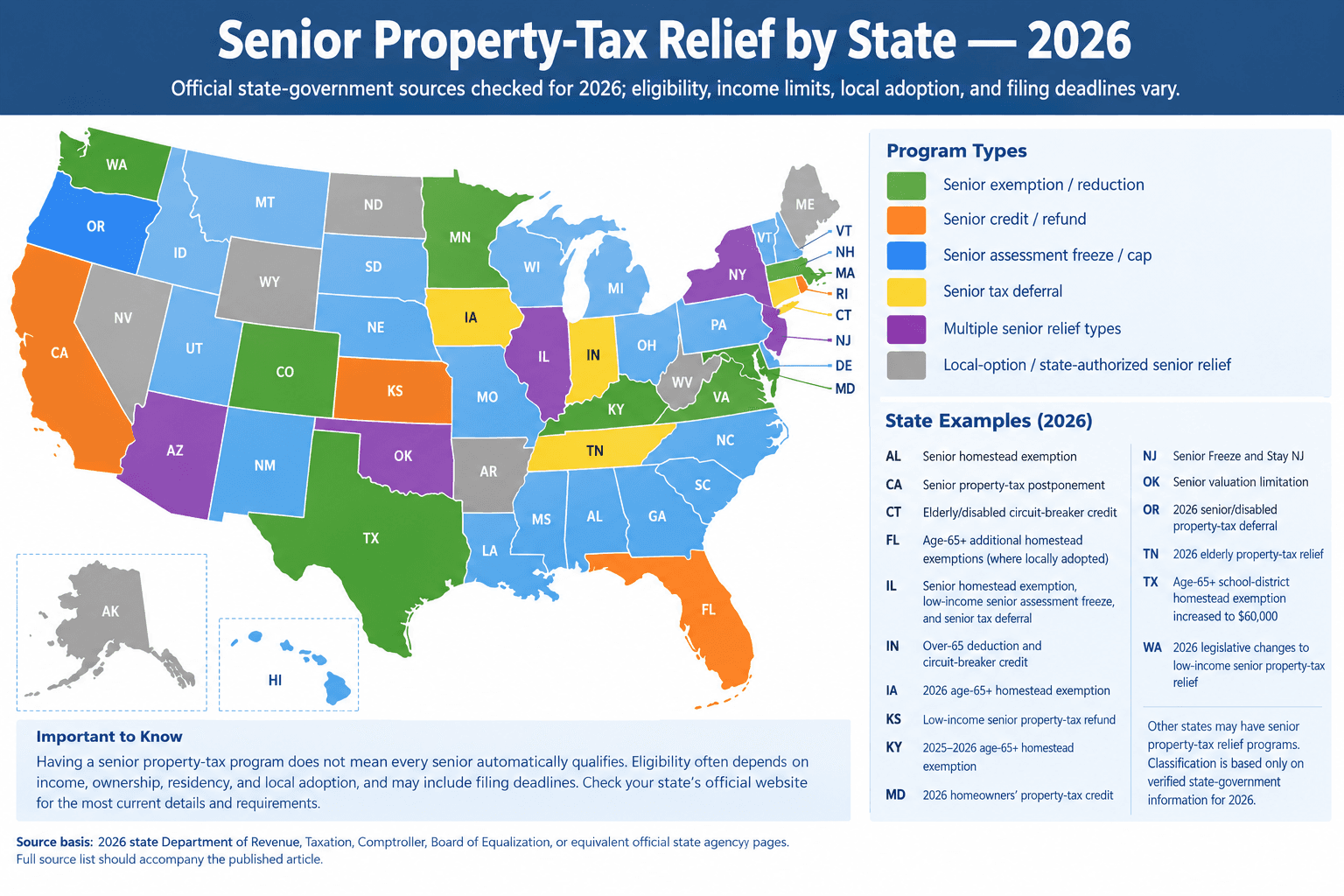
The Main Types of Senior Property Tax Relief
Programs differ by state, but most fall into a few clear categories.
Property tax freezes
A freeze locks the assessed value or the tax amount at a certain point, often when the homeowner reaches a set age. Future increases in home value no longer raise the tax bill. Some freezes apply only to the portion of the tax that goes to schools or local services.
Property tax deferrals
A deferral allows eligible seniors to postpone payment of some or all property taxes. The deferred amount becomes a lien on the home and is usually repaid when the house is sold or the owner dies. Interest may or may not be charged, depending on the state.
Exemptions and homestead reductions
Many states reduce the taxable value of a primary residence for older owners or for those with lower incomes. The reduction can be a fixed dollar amount or a percentage of the assessed value.
Circuit-breaker credits
These programs refund or credit a portion of property taxes when the tax bill exceeds a certain percentage of household income. They function more like a rebate than a reduction in the assessed value.
According to the AARP Foundation Property Tax-Aide program, millions of older adults qualify for one or more of these forms of relief yet many never apply. The Foundation maintains a free online screener that matches users with state-administered programs.
How Relief Programs Interact with a Reverse Mortgage
A reverse mortgage does not remove the duty to pay property taxes. The loan documents treat unpaid taxes as a serious default risk. Here is how the main relief options typically work with a HECM:
- A tax freeze or exemption lowers the annual bill. This can make it easier to stay current without drawing extra cash from the reverse mortgage line of credit.
- A deferral postpones the tax payment. Because the deferred taxes become a lien, most reverse mortgage servicers require written approval before the deferral can be put in place. Without that approval, the servicer may treat the unpaid taxes as a violation of the loan terms.
- Some states limit the total liens that can sit against the property. A large deferred tax balance plus the reverse mortgage balance can affect eligibility for future draws or for refinancing the HECM later.
The practical result is straightforward. Before applying for a deferral, contact the reverse mortgage servicer and ask what documentation they need. Most will request a copy of the deferral application and written confirmation that the program will not jeopardize their first-lien position.
Practical Steps to Find and Claim Relief
- Start with the free AARP Foundation Property Tax-Aide screener. It asks a few questions about age, income, and location and then lists programs you may qualify for.
- Visit your state department of revenue or local assessor’s website. Search for “senior property tax relief,” “homestead exemption,” or “tax deferral.”
- Gather the usual documents: proof of age, proof of income, deed or property tax bill, and Social Security award letter if needed.
- If you already have a reverse mortgage, call the servicer before submitting a deferral application. Ask for their written approval process.
- Note application deadlines. Many programs open early in the year and close by a fixed date such as September 1 or December 31.
Comparison of Common Relief Options
| Program Type | How It Works | Effect on Reverse Mortgage | Typical Requirements |
|---|---|---|---|
| Tax Freeze | Locks assessed value or tax amount | Lowers annual bill; easier to stay current | Age (often 65+), sometimes income or residency length |
| Tax Deferral | Postpones payment; creates lien | Requires lender approval; repaid at sale or death | Age, income limits, primary residence, no prior delinquencies |
| Homestead Exemption | Reduces taxable value | Lowers bill without creating new lien | Age or disability, primary residence |
| Circuit Breaker | Refunds portion of taxes based on income | No lien; pure cash relief | Income relative to tax bill |
Is Relief Right for You Right Now?
Use this short list to decide your next step.
- My property tax bill has risen noticeably in the last two years.
- I am 65 or older (or the age set by my state).
- My household income falls within the limits published by my state.
- I want to stay in this home for the foreseeable future.
- I already have, or am considering, a reverse mortgage and need to keep taxes current.
If you checked three or more boxes, spending an hour with your state’s relief information is likely worthwhile.
Other Ways Sagewise Can Support Your Home Decisions
Property tax pressure is often only one part of the larger picture. Many readers who explore tax relief also look at related options:
- A reverse mortgage can eliminate the traditional monthly mortgage payment and free cash for taxes, insurance, or home maintenance.
- Home equity products such as a HELOC or cash-out refinance can fund necessary repairs without draining retirement accounts.
- A home warranty can limit the surprise cost of appliance or system failures that often appear in older houses.
- Walk-in tubs and other aging-in-place modifications can make the home safer so the decision to stay becomes easier.
Sagewise is an independent comparison service. We do not sell insurance or originate loans. We simply help you review clear information and, if you choose, connect with pre-vetted providers at no cost and with no obligation.
Frequently Asked Questions
Do I still have to pay property taxes if I have a reverse mortgage?
Yes. The loan requires you to keep taxes, homeowners insurance, and the home itself in good condition. Unpaid taxes can lead to default.
Will a tax deferral hurt my reverse mortgage?
It can if the lender has not approved it in writing. Most servicers will approve a legitimate state deferral once they confirm their lien position remains protected.
Are these programs only for low-income seniors?
No. Some freezes and exemptions have no income limit. Others, such as circuit breakers and many deferrals, do set income ceilings. Check your specific state rules.
Where can I find the most accurate list of programs for my state?
The AARP Foundation Property Tax-Aide tool and your state department of revenue website are the two most reliable starting points.
What if my taxes are already past due?
Contact your local tax collector immediately. Many programs require that taxes not be delinquent at the time of application. Early communication often opens options that disappear once liens are filed.
Next Steps You Can Take Today
Property taxes do not have to force a move or create constant worry. Relief programs exist in nearly every state, and a reverse mortgage can still serve as a useful cash-flow tool when taxes are managed carefully.
If you would like to explore whether a reverse mortgage or another home equity option fits your situation, Sagewise can match you with licensed providers who understand senior needs. The process is free, private, and carries no obligation.
You can also review related guides on reverse mortgage requirements and home equity choices on the Sagewise site to build a fuller picture before making any decision.
Your home should support your life, not strain it. Clear information about tax relief and equity options is one practical way to keep that balance.
This guide is for general education and isn't individual financial, insurance, legal or tax advice. Spot an error? Tell us and we'll review it under our corrections policy.